


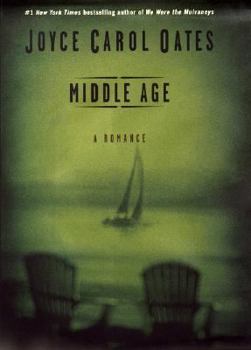
Middle Age: A Romance

Select Format
Select Condition 
Book Overview
A darkly comic novel from the author of Blonde and We Were the Mulvaneys In Salthill-on-Hudson, a half-hour train ride from Manhattan, everyone is rich, beautiful, and -- though they look much younger -- middle-age. But when Adam Berendt, a charismatic, mysterious sculptor, dies suddenly in a brash act of heroism, shock waves rock the town. But who was Adam Berendt? Was he in fact a hero, or someone more flawed and human? His loss and the rumor that surface of his possible lovers plunge his friends into grief, confusion, and self-reflection. The women who loved Adam find themselves engaging in life-altering romantic adventures. The men who were Adam's closest friends become utterly transformed in his absence. Adam's lawyer, Roger Cavenagh, who has broken the law for Adam's sake, becomes invlolve with an elusive and perhaps treacherous young woman. Marina Troy exiles herself to fullfill a wish Adam had made for her. Lionel Hoffman sets out, unwisely but with great hope, to recapture his lost youth after a lifetime of soulless financial success, even as his wife, Camille, discovers an unspeckable joy close to home. Augusta Cutler, a hitherto sensuous, unreflective woman defiantly endeavors to solve the mystery of Adam's origins, even if it means losing her marriage and family. Middle Age: A Romance is an intimately drawn, richly sympathetic, yet unsparingly comic portrait of the affluent class at the dawn of the twenty-first century. Incisive, insightful, and never predictable, it's a uniquely American sage of self-determination and identity from one of our finest writers of contemporary fiction.
Format:Hardcover
Language:English
ISBN:0066209463
ISBN13:9780066209463
Release Date:September 2001
Publisher:Ecco
Length:480 Pages
Weight:2.05 lbs.
Dimensions:9.3" x 1.6" x 6.3"
Related Subjects
Contemporary Fiction Literary Literature & Fiction Mystery, Thriller & Suspense RomanceCustomer Reviews
5 ratings
Oates' Best Novel Of This Decade
Published by Thriftbooks.com User , 20 years ago
What a delight Middle Age: A Romance was to read! It is a stirringly complex book in which a huge cast of characters share center stage as they intertwine, interact, and face their personal quests for self-respect, liberation, or understanding. Set in upstate New York among the monetarily-privileged (but achingly insecure and empty) of the turn of the twenty-first century, this novel begins when one of the town's most beloved and mysterious figures dies what appears from all angles to be a most heroic death. From there America's most accomplished woman of letters, Joyce Carol Oates, leads the reader along on a surprisingly fast-paced story of exactly how this single death impacts an entire town, and how it sets into motion a multitude of major and minor events that leave so many of those within the story changed. And (in saying this here and now I in no way spoil anything) unlike so many literary outings with Oates, this solid novel of evolution and revelation ends on a happy note as it ties up its loose ends in positive and satisfying ways for all concerned. Middle Age: A Romance is a really good book that should unite a large cross section of readership in glowing praise at its author's awesome talent.
"The Philosopher Is One Who Practices Dying, Practices Death ..."
Published by Thriftbooks.com User , 20 years ago
In this extraordinary rendition, Ms. Oates has created another masterpiece. Her writing is finely honed and truly expressive to an extent not quite seen in her prior work. She continues to progress to a highly unique and enticing writing style. The words flow from the page to the reader in a continuous and effortless manner. The book is arguably, the best novel she has ever penned. But her writing style in the book is only a small part of its greatness. With a special finesse, Oates captures the interesting and infinitely varied milieu of "Middle Age." In Middle Age people find themselves in a very different state than when they were young. The overwhelming feeling of emptiness that is exhibited by those who reach this stage so often; resulting from the disillusionments of youth ended and the "empty nest" phenomenon that forces people to truly look at their lives; to evaluate their progress or lack thereof; to re-interpret their lives of marriage and children, now grown. It is in middle age that people become philosophical about what has transpired in their whole prior life. Did it represent fulfillment, or merely an empty life of going through the motions? Do they relate to their spouses anymore, or have they grown to a point where they no longer even see each other in the same room? In fact, do we even dislike or in the extreme even hate our spouse, our life, our children, our house, our whole worthless or non-worthless life up to that point? These concepts are those that Joyce Carol Oates examines in this book. The text examines the loves, the hates, the cruelties, the deceptions, the disillusionments and the feelings derived thereof; following the prime of life. And then, the manner in which we interpret it. And if we find that this life was not satisfactory, to where do we go, to what place do we run, to what satisfaction can we find in a changed environment? Joyce takes the reader down these roads. She describes the infidelities and the fidelities incurred in the vicissitudes of everyday life over a period of 50 years and how we see it. Her characters are varied and deeply developed. Rather than only one central character, Ms. Oates uses a small bunch of characters. The necessity of this is unavoidable, as middle age is a condition that varies in a colossal manner from one person to another. The book relates these almost unanswerable questions; and allows the reader to self-evaluate their own life experiences and accomplishments. Some of us are embittered. Some of us are grateful. Some of us are disillusioned. Some of us are suicidal. Some of us are not sure what we are as we have not contemplated it in this way, this philosophical approach to the sum of our acts and deeds are what middle aged people tend to dissect. And through that process of dissection and analysis, people then determine what will be the rest of their life's course. Should they continue as they have? Should they chuck it all and run away? S
My first Oates read
Published by Thriftbooks.com User , 24 years ago
An avid reader I have glanced at Joyce Carol Oates books in the past and something about the writing style has turned me away...The write up on Middle Age got my attention and though I started it hesitantly once it's 500+ grabbed me (which only took a chapter or two) I didn't want it to end. Each character was so deftly created and had some trait that set them completely apart from all the others - the woman with all the dogs which ended up being a bit of a disaster at the end...the relationships depicted between the children and their parents...All the characters went through major life quests and changes in this story which gives such a hopeful note to the human condition...and what about the mystery which still surrounded Adam at the end. One question I was left with at the end of the novel concerned Adam's sexuality - all the women were entranced/in love with him yet it seemed that he did not have a sexual relationship with any of them - was he gay? Because of my enjoyment of this novel I am jumping on the bandwagon and have We Were the Mulvaneys waiting in my pile to read.
Middle Aged Insight
Published by Thriftbooks.com User , 24 years ago
I worship Joyce Carol Oates. I am amazed by her insightfulness, by the complexity of her characters, and by the sheer quantity of her work. Her subjects range in class and income from the disgruntled marginal (FOXFIRE) to the seemingly contented middle class (WE WERE THE MULVANEYS) to the wealthy. MIDDLE AGE takes on the wealthy, excluding as she says in her preface, "(her) Princeton friends, who are nowhere in these pages." Salthill-on-Hudson is a picturesque suburban village half an hour from Manhattan. It's residents are all beautiful, rich, and middle-aged. The only obvious misfit -- the mysterious sculptor Adam Berendt -- is a breath of fresh air in a stifling environment. His sudden half-heroic death while attempting to save a child from an overturned boat is a shock wave that reverberates through the community. Those affected include sleek lawyer Adam Cavanagh who lies to save Adam's reputation, sculptress and book store owner Marina Troy to whom Adam bequests a second chance for an artistic life, smug Lionel Hoffmann bent on reclaiming his youthful vibrancy, fragile Camille whose life seems empty without the wandering Lionel, and crazed Augusta Cutler who is determined to make a new start. Be prepared to laugh and reflect.
Starting New
Published by Thriftbooks.com User , 24 years ago
Middle Age is about several upper class characters exploring potential new paths at the mid-point of their lives. At its centre is Adam Berendt whose life is unexpectedly cut off, but whose influence and Socratic interrogation of life acts as a catalyst to transform his friends in the tight-knit community of Salthill. Their lives, as they understand them, dissolve upon his death to be reformed. The mystery of Adam's past is threaded throughout the novel opening dozens of different possible beginnings to his life at the same time as multiple endings to the other characters' lives are imagined. Oates' tremendous skill is to draw a multitude of realistic detail while emotionally constructing her characters' thoughts. This method works to unearth strange revelations in her contemplation of mortality and the depthless possibilities of experience. The characters tear off the costumes of their present identity to wear new masks and reconstitute their sense of being. Marina Troy's potentiality as an artist has lain dormant for many years, but, through Adam's bequest of a residence for solitude, she is given the possibility of expressing her vision. Augusta Cutler leaves her secure life to pursue dangerous new possibilities and trace Adam's past. These stories as well as those of the other characters are told in a revolving narrative focus that juxtaposes the characters' intentions with the dramatic realizations of their experiences. Their middle age lives turn out not to be about just endings, but multiple beginnings as well. The novel gives a heartfelt portrait of characters that identify themselves alternatively as amorphous and fabled beings and desperate to break from their identification of an ordinary life.
Copyright © 2026 Thriftbooks.com
Terms of Use | Privacy Policy | Do Not Sell/Share My Personal Information | Cookie Policy | Cookie Preferences | Accessibility Statement
ThriftBooks ® and the ThriftBooks ® logo are registered trademarks of Thrift Books Global, LLC
ThriftBooks ® and the ThriftBooks ® logo are registered trademarks of Thrift Books Global, LLC
