


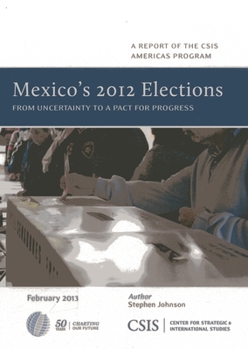
Mexico's 2012 Elections: From Uncertainty to a Pact for Progress
No Customer Reviews

At the beginning of 2011, security defined the U.S.-Mexico relationship, and it was the issue that most observers thought would shape Mexico's 2012 presidential, state, and local elections. Only two of Mexico's three main parties, the National Action Party (PAN) and Democratic Revolutionary Party (PRD), had well-known positions on security and on themes such as economic liberalization, rule of law, and reform of the energy sector. After the election, changes began to occur. A labor bill that Calderon introduced in the new Congress passed both chambers largely intact with the new president-elect's support, setting the stage for multipartisan cooperation. Similarly, in December, Congress enacted a constitutional change in education, and a supermajority of states seems destined to approve it. It remains to be seen whether that sense of compromise among Mexico's three dominant parties will prevail for other key initiatives, including telecommunications, taxes, energy reform, and public safety. Yet, where there was uncertainty about the course Mexico would take leading up to the 2012 elections, the new administration has committed itself to the principles of effective government, with public opinion playing a supporting role.
Format:Paperback
Language:English
ISBN:1442224533
ISBN13:9781442224537
Release Date:June 2013
Publisher:Center for Strategic & International Studies
Length:24 Pages
Weight:0.15 lbs.
Dimensions:0.0" x 8.5" x 11.0"
Customer Reviews
0 rating
Copyright © 2026 Thriftbooks.com Terms of Use
| Privacy Policy | Do Not
Sell/Share My Personal Information | Cookie Policy | Cookie Preferences | Accessibility Statement
ThriftBooks® and the ThriftBooks® logo are registered trademarks of Thrift Books Global, LLC
ThriftBooks® and the ThriftBooks® logo are registered trademarks of Thrift Books Global, LLC
