


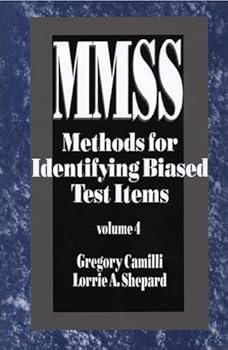
Methods for Identifying Biased Test Items (Measurement Methods for the Social Science)

Select Format
Select Condition 
Book Overview
This book makes clear to researchers what item-bias methods can (and cannot) do, how they work and how they should be interpreted. Advice is provided on the most useful methods for particular test situations. The authors explain the logic of each method - from item-response theory to nonparametric, categorical methods - in terms of how differential item functioning (DIF) is defined by the method and how well the method can be expected to work. A summary of findings on the behaviour of indices in empirical studies is included. The book concludes with a set of principles for deciding when DIF should be interpreted as evidence of bias.
Format:Hardcover
Language:English
ISBN:0803944152
ISBN13:9780803944152
Release Date:April 1994
Publisher:SAGE Publications, Inc
Length:181 Pages
Weight:0.85 lbs.
Dimensions:8.8" x 5.8" x 5.8"
Related Subjects
Assessment Business Business & Finance Business & Investing Economics Education Education & Reference Education Theory Health, Fitness & Dieting Health, Fitness & Dieting Mathematics Politics & Social Sciences Psychology Psychology & Counseling Reference Research Science & Math Social Science Social Sciences TextbooksCustomer Reviews
1 rating
Very helpful, practical information
Published by Thriftbooks.com User , 24 years ago
As a graduate student in Measurement and Research and as a new employee for a testing company, I needed a good foundation in differential item functioning (DIF) in order to be able to do DIF studies. After pulling relevant articles from the library, I realized I needed some background on this topic before it would really make sense to me. This book helped a lot. The background information on how DIF relates to validity as well as what DIF studies can and cannot accomplish set the stage for a clearer understanding of the actual analyses.I was especially pleased to find SAS code for the Mantel-Haenszel procedure. Also included was a very helpful BILOG example for use in DIF studies that utilize IRT methods. I'm still reading, but in one weekend have gone from complete novice with barely a definitional understanding of DIF to comprehending why such studies are valuable, the history of DIF analysis, and a good idea of how to proceed to do DIF analysis.
Copyright © 2026 Thriftbooks.com Terms of Use
| Privacy Policy | Do Not
Sell/Share My Personal Information | Cookie Policy | Cookie Preferences | Accessibility Statement
ThriftBooks® and the ThriftBooks® logo are registered trademarks of Thrift Books Global, LLC
ThriftBooks® and the ThriftBooks® logo are registered trademarks of Thrift Books Global, LLC
