


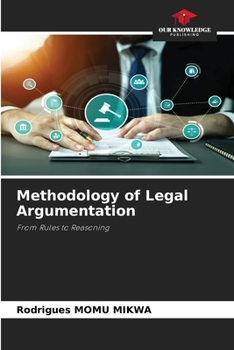
Methodology of Legal Argumentation
No Customer Reviews

This book offers a structured analysis of legal reasoning, breaking with traditional views that reduce it to a mere mechanical application of the rule of law. It argues that law does not function as a closed deductive system, but as a process of intellectual construction subject to normative constraints.The study first demonstrates that legal facts are never given as such: they are selected, organized, and transformed through processes of legal characterization. It then highlights the central role of the interpretation of legal norms, which goes beyond a literal reading and draws on teleological and systemic reasoning, thereby opening the way to several possible solutions.The book also analyzes the role of case law as an argumentative tool, serving as both a source of authority and a means of justification. It emphasizes the constructed and hierarchical nature of legal reasoning, in which arguments are structured, directed, and confronted with objections. Finally, it proposes an integrated model of legal reasoning structured around four stages: norm, qualification, argument
Format:Paperback
Language:English
ISBN:6630223624
ISBN13:9786630223620
Release Date:July 2026
Publisher:Our Knowledge Publishing
Length:60 Pages
Weight:0.21 lbs.
Dimensions:0.1" x 6.0" x 9.0"
Related Subjects
LawCustomer Reviews
0 rating
Copyright © 2026 Thriftbooks.com
Terms of Use | Privacy Policy | Do Not Sell/Share My Personal Information | Cookie Policy | Cookie Preferences | Accessibility Statement
ThriftBooks ® and the ThriftBooks ® logo are registered trademarks of Thrift Books Global, LLC
ThriftBooks ® and the ThriftBooks ® logo are registered trademarks of Thrift Books Global, LLC
