


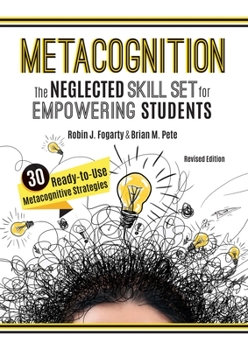
Metacognition: The Neglected Skill Set for Empowering Students

Empower your students to become mindful, reflective, and proficient thinkers and problem solvers. In Metacognition, authors Robin J. Fogarty and Brian M. Pete provide a practical framework to nurture these essential skills in every learner. Research-based and classroom-approved, this resource is a must-read for educators committed to strengthening student self-awareness, self-assessment, and self-confidence for school and life.
Use this resource to implement the critical but overlooked practice of enhancing deep, reflective learning among students in the classroom: Explore research that shows teaching metacognition--or reflective thinking--is one of the most high-impact strategies available to educators. Acquire practices designed to empower learners to cultivate awareness and control over their own thinking. Learn how to encourage students with positive feedback to go beyond the "right" answer by thinking deeply and critically. Study the three categorical labels for the strategies that will help students develop metacognitive behaviors: (1) planning, (2) monitoring, and (3) evaluating. Record and reflect on how you incorporate the teaching strategies into your classroom.
Contents:
Table of Contents
Foreword
Introduction
Section I: Planning Strategies
1. Stem Statements Thoughtful Lead-Ins]
2. Inking Your Thinking Learning Logs]
3. Film Footage Visualization]
4. Fat and Skinny Questions Higher-Order Questions]
5. Roll the Dice Predicting]
6. Pie in the Face Making Inferences]
7. The Goal Post Goal Setting]
8. A Road Map Strategic Planning]
9. Seesaw Thinking What-If Problem Solving]
10. Prime the Pump KWL]
Section II: Monitoring Strategies
1. Talk to Yourself Think Aloud]
2. Soup Cans Labeling Behaviors]
3. Alarm Clock Recovery Strategies]
4. Instant Replay Tape Recordings]
5. Sticky Note Memoing]
6. Mental Menus Tracking]
7. Cue Cards Prompting]
8. Two-Way Talk Conferencing]
9. Transfer Talk Bridging]
10. The Microscope Recorded Observations]
Section III: Evaluating Strategies
1. Thumbs-Up/Thumbs-Down PMI]
2. Choose Your Spot The Human Graph]
3. Mrs. Potter's Questions Evaluating]
4. A Revolving Door The Portfolio Registry]
5. Connecting Elephants How Can I Use This?]
6. The Big Idea Generalizing]
7. Checkmate Self-Administered Checklists]
8. What? So What? Now What? Student-Led Conferences]
9. Story Time Anecdotes]
10. Double-Talk Double-Entry Journals]
In Closing
References and Resources
Index
Customer Reviews
ThriftBooks ® and the ThriftBooks ® logo are registered trademarks of Thrift Books Global, LLC
