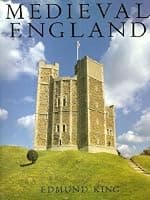
Medieval England presents the political and cultural development of English society from the Norman Conquest to the end of the Wars of the Roses. It is a story of change, progress, setback, and consolidation, with England emerging as a wealthy and stable country, many of whose essential features were to remain unchanged until the Industrial Revolution. Edmund King traces his chronicle through the lives of successive monarchs, the inescapable central thread of that epoch. The momentous events of the times are also recreated, from the compiling of the Domesday Book, through the wars with the Scots, the Welsh, and the French, to the Peasants' Revolt and the disastrous Black Death.
Traces the emergence of England as a unified political nation, and at the same time presents a broad
By Thriftbooks.com User, August 19, 2007
This text is a bit strong on the central narrative, but I really enjoyed reading of the broad panorama, political and cultural development of the English Society from the Norman Conquest to the end of the Wars of the Roses. It is the story of change, progress, setbacks and consolidation, with England emerging as a wealthy and stable country, many of whose essential features were to remain unchanged until the Industrial Revolution. Within the framework of the book "King" examines many other facets of medieval England, including religion and learning, agriculture and economic developments, the machinery of government, the administration of justice, warfare and chivalry, everyday life, art and architecture. A very fine book....
0
★★★★☆
The good olde days
By Thriftbooks.com User, July 7, 2006
Some periods and places in history are more interesting than others; it just depends on your interests. With American history, I enjoy reading about the Revolutionary era, but I'm not as much into the Civil War. With others, it could be the reverse. When it comes to English history, I find the more modern period tedious, but I enjoy reading about the early monarchy, especially from William the Conqueror to Elizabeth. This time span was mostly in the Middle Age times which Edmund King covers in his book, Medieval England, which covers the period from William's conquest of England to the conclusion of the War of the Roses, a timespan of roughly 400 years. Superficially, this seems like a rather adventurous era filled with larger than life characters. This is the time of the heroic Richard the Lion Heart and Henry V as well as the villainous King John and Richard III. It was the era that produced the real life Braveheart, William Wallace as well as the legendary Robin Hood, a period that Shakespeare would write ten plays about (King John, Edward III (which Shakespeare co-wrote), Richard II, Henry IV Parts One and Two, Henry V, Henry VI Parts One to Three and Richard III). Of course, in reality, medieval England was a more complicated place. Edmund King's provides a more realistic look of the period in his brief (less than 300 pages) book. No person is simply good or evil, though some are definitely more brilliant than others. Even the more successful monarchs, such as Henry II and Edward I, had their problems. King presents the early English epoch as one in constant flux but definitely evolving from a feudal society of royalty and nobles to the beginnings of a more modern England with king (or queen) and Parliament. King's writing is always informative, but not always interesting. He's not a bad writer, but stylistically, he is sometimes a bit tiring. There are, however, some nice illustrations, so I'll push it up from a high three stars to a low four. Although King knows his stuff and this is probably the best book I've read on this period, I still think there are better ones out there; I just haven't found them yet.