


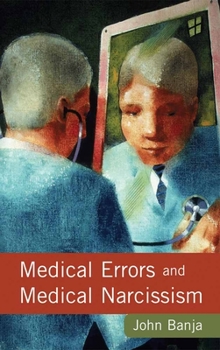
Medical Errors and Medical Narcissism


How a medical error should be defined and how serious, harm-causing errors usually occur in institutions
Common psychological reactions of health professionals to the commission of a serious harm-causing error that often leads to concealing the error
Common psychological reactions of health professionals to the commission of a serious harm-causing error that often leads to concealing the error
Format:Paperback
Language:English
ISBN:0763783617
ISBN13:9780763783617
Release Date:December 2004
Publisher:Jones & Bartlett Publishers
Length:229 Pages
Weight:1.04 lbs.
Dimensions:0.7" x 6.3" x 9.3"
Customer Reviews
2 ratings
Medical Errors and Medical Narcissism
Published by Thriftbooks.com User , 16 years ago
The book gives a good explanation of the complexity of the medical culture in relation to medical errors.
The appearance of the physician in Metamorphoses
Published by Thriftbooks.com User , 17 years ago
Published almost four years ago at the time of this review, it is rather interesting that other readers have not yet shared their thoughts about this book. Quite simply, this is an extremely well written, well organized text, and the subject matter is relevant to a large segment of society. Health care touches almost everyone, and understanding the mind of the health care worker, especially the physician, is important when assessing medical errors. According to author Banja, Associate Professor in the Center for Ethics at Emory University, behavior that he refers to as "medical narcissism" can have a profound influence on how the physician reacts to occurrences of such errors. Before Banja discusses narcissism in health care, he first explains error and rationalization, and follows the discussion of narcissism with chapters on forgiveness, remedies, and empathic disclosure. The author indicates that "it is important to note that the variance, departure, or straying from the standard of care that is presently being offered as a definition of error must be morally problematic, or uncomprehending, or unintended by the actor. Simply calling an error 'a failure to accommodate the standard of care' would imply that medicine could not have progressed since Hippocrates without its practitioners making 'errors', which seems intuitively wrong. The failure to follow the standard of care, then, must be unwarranted and, overwhelmingly, the errors discussed in this book are just so". And "it is grossly unfair to hold health professionals to a standard of competence that defines 'error' in a way that exceeds ordinary and reasonable levels of performance. Because imputing error can have onerous repercussions, health professionals and especially risk managers must insist on a coherent understanding of error and resist imprecise definitions that could confuse or compromise hospital policy on patient safety and managing adverse outcomes. Consequently, the definition of error that will be used throughout this book is: 'An error is an unwarranted failure of action or judgment to accommodate the standard of care'." Following his discussion of medical errors, Banja then takes a look at how such errors are handled, providing many examples of such scenarios, which suggest "a temporally tight juxtaposition of immense anxiety and concern for the patient's welfare, followed closely or even simultaneously by the provider's intense anxiety about his or her own welfare. The lock-step nature of these dual anxieties is key". As the author continues with his presentation, he indicates that it is unfortunate that there is no national consensus (i.e. within the United States) that dictates how such errors need to be communicated to affected parties. According to cited studies, what is often the case is that information associated with such errors is withheld, and in one study where disclosure practices of over 200 hospitals were examined, the conclusion was that only 10% to 20% of
Copyright © 2026 Thriftbooks.com
Terms of Use | Privacy Policy | Do Not Sell/Share My Personal Information | Cookie Policy | Cookie Preferences | Accessibility Statement
ThriftBooks ® and the ThriftBooks ® logo are registered trademarks of Thrift Books Global, LLC
ThriftBooks ® and the ThriftBooks ® logo are registered trademarks of Thrift Books Global, LLC
