
Skip to content
Scan a barcode
Scan
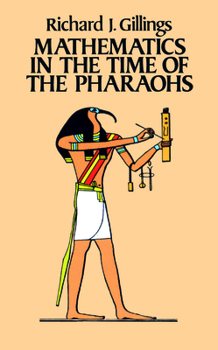
Paperback Mathematics in the Time of the Pharaohs Book

ISBN: 048624315X

ISBN13: 9780486243153

Mathematics in the Time of the Pharaohs

Select Format

Select Condition ThriftBooks Help Icon

Recommended

Format: Paperback

Condition: Acceptable

$6.89
Save $8.06!
List Price $14.95
Almost Gone, Only 2 Left!
Save to List

Book Overview

In the past, scholars have tended to dismiss the mathematics of the ancient Egyptians as "child's play," compared with the achievements of the Greeks and other later civilizations. Nevertheless, in a society that achieved the marvelous accuracy of construction revealed in the Pyramids, extensive systems of irrigation canals, the erection of large granaries, levying and collecting of taxes, and other evidences of a well-organized and highly developed culture, mathematics must have played a major role.
In this remarkably erudite work, the first book-length study of ancient Egyptian mathematics, Professor Gillings examines the development of Egyptian mathematics from its origins in commercial and practical computations to such accomplishments as the solution of problems in direct and inverse proportion; the solution of linear equations of the first degree; determining the sum of arithmetical and geometrical progressions, and the use of rudimentary trigonometric functions in describing the slopes of pyramids. Drawing on all the extant sources -- Egyptian Mathematical Leather Roll, the Reisner Papyri, the Moscow Mathematical Papyrus, and, most extensively, the Rhind Mathematical Papyrus, a training manual for scribes- the author shows that although the mathematical operations of the ancient Egyptians were limited in number, they were adaptable to a great many applications. Professor Gillings is also at pains to debunk such myths as the numerical mysticism that arose in connection with the construction of the great Pyramids, and the oft-repeated assertion that the Egyptians were conversant with the Pythagorean Theorem.
Enhanced with photographs of age-old papyri and other artifacts, as well as the author's own calligraphic renderings of hieroglyphic and hieratic words and numerals, this carefully researched and well-presented study will fascinate Egyptologists, mathematicians, engineers, archaeologists, and any student or admirer of the remarkable civilization that flourished on the shores of the Nile so many centuries ago.

Customer Reviews

2 ratings

Gillings' errors and omissions

Gillings attempted to bring together all the known hieratic mathematical texts was well thought out. Even the Akhmim Wooden Tablet was mentioned as a footnote, though not analyzed in any section of his otherwise excellent book. Taken together all the Middle Kingdom math texts should be read as one document, one text checking the other for errors and omissions. In great part Gillings attempted to follow this rule. Exceptions lie in reporting of several texts, or aspects of texts, as individual documents. Three of the texts are the Egyptian Mathematical Leather Roll, the Reisner Papyri and the RMP. All three texts are fully reported by Gillings, though seemingly minor oversights became major oversights when each oversight is placed in the context within the great whole of scribal mathemetics. Concering the EMLR, Gillings' oversight consisted of four of the 26 lines of texts, only reporting them as additive in scope, as were the other 22 lines. Actually a higher form of abstract arithmetic should have been discussed as potentially present. The Reisner Papyri was discussed as containing quotients, which it does. Gillings' oversight was not mentioning the remainders that filled the scribal overseer notes from a construction site where daily worker digging rates were measured in units of 10. Hence all of the digging rates were divided by 10, and were reported by the scribe as quotient and remainder totals, a remainder arithmetic fact that escaped Gillings analysis. One scribal error was corrected by Gillings, properly listing a quotient and remainder; however, the proper modern name for the ancient arithmetic was not potentiallly commented upon by Gillings. Finally, throughout the RMP quotients and remainders fill the document for almost every division and subtraction that Ahmes reported in his 84 problems. Yet, again, only quotients are mentioned, from time to time, with the remainder aspect of Egyptian fractions often being the major component not being commented upon. A clear example of Gillings' oversight is cited on page 250 "Horus-Eye fractions in terms of hin", where 29 divisions of a hekat, a volume unit, were divided by rational numbers in the range 1/64 to 64, with each answer written down as quotients and remainders. All of the two-part statements were created from the hekat unity, (64/64), being divided by a divisor n, or: (64/64)/n = Q/64 + (R5/n)*1/320, with Q the quotient and R the remainder. As a passing comment, Gillings also missed Ahmes' hin rule, 1/10 of the hekat, creating a one-part number by using 10/n hin, as listed 29 in the table, the additive context in which Gillings incorrectly reported the totality of the table. Returning the the Akhmim Wooden Tablet, it also reported in vivid terms, the hekat unity (64/64) division by 3, 7, 10, 11 and 13, using quotients and remainders, an abstract form of arithmetic, as used in the EMlR. G. Daressy first reported aspects of these facts to the world in 1906. Yet, Gillings cited none

All I ever wanted to know about the mathematical papyri.

The Rhind, Moscow, and other important mathematical papyri decoded in every detail. A sweeping tour through the ancient Egyptian methods of calculation, parts of which are still used today in computer code! In his well-written account, Mr. Gillings makes it very clear that the common view on ancient Egyptian mathematics as 'rather primitive' is definitely to be revised. Provided with a few basic tools, the scribes of the epoch were able to carry out very complicated computations indeed, at times involving several different units. Their rough-and-ready estimate of pi was off by only 0.6 percent as compared to the correct value. The author presents a rich variety of calculated examples and explains the logic behind them. Earlier researchers in the field are commented.
Copyright © 2026 Thriftbooks.com Terms of Use | Privacy Policy | Do Not Sell/Share My Personal Information | Cookie Policy | Cookie Preferences | Accessibility Statement
ThriftBooks® and the ThriftBooks® logo are registered trademarks of Thrift Books Global, LLC

GoDaddy Verified and Secured