


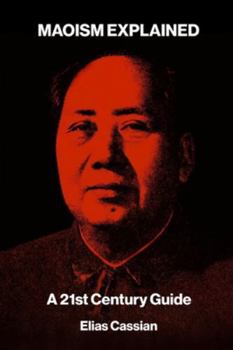
Maoism Explained: A 21st Century Guide

Maoism transformed the world's most populous nation, inspired revolutionary movements across the globe, and caused the deaths of tens of millions of people. Yet for many readers today, it remains poorly understood-reduced to images of the Little Red Book and the Cultural Revolution without the context that makes this history comprehensible.
Maoism Explained: A 21st-Century Guide offers a complete introduction to this complex and contested subject. Written for curious, intelligent readers with no prior background, it traces Maoism from its origins in early twentieth-century China through its development as a distinctive body of revolutionary theory, its application in the People's Republic, its spread to movements worldwide, and its contested legacy today.
The book examines Maoist ideas on their own terms-the theory of peasant revolution, protracted people's war, the mass line, continuous revolution-while honestly confronting what happened when those ideas met reality. It documents the Great Leap Forward famine that killed an estimated 30-45 million people, the decade of chaos and violence during the Cultural Revolution, and the brutal outcomes of Maoist movements in Cambodia, Peru, and elsewhere.
Neither celebration nor condemnation, this guide presents the strongest version of Maoist ideas alongside the strongest criticisms. It offers frameworks for assessment while trusting readers to reach their own conclusions.
Complete with a glossary of key terms, a detailed timeline of major events, and an annotated guide to further reading, Maoism Explained is the essential starting point for anyone seeking to understand one of the twentieth century's most significant and troubling political phenomena.
Customer Reviews
ThriftBooks ® and the ThriftBooks ® logo are registered trademarks of Thrift Books Global, LLC
