


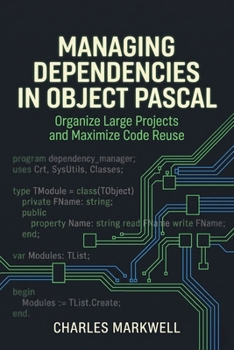
Managing Dependencies in Object Pascal: Organize Large Projects and Maximize Code Reuse

Untangle Your Codebase, Eliminate Circular References, and Build Scalable Object Pascal Systems
Starting a new project in Object Pascal is a fast, deeply productive experience. Yet as applications grow over the years to encompass hundreds or thousands of units, unmanaged dependencies can turn a clean architecture into a fragile, monolithic web. Compile times slow to a crawl, minor user interface changes break core business logic, and circular unit references halt your progress.
Managing Dependencies in Object Pascal is the definitive architectural guide to organizing large-scale projects, isolating domain logic, and maximizing code reuse across Delphi, Free Pascal, and Lazarus environments. Written for software engineers, architects, and maintainers of enterprise systems, this book moves beyond basic syntax to show you how the compiler resolves relationships and how you can use native language features to enforce strict, maintainable boundaries.
What You Will Learn:
Master the Object Pascal Unit: Treat interface and implementation sections as strict design boundaries to hide private state, prevent namespace shadowing, and drastically reduce recompilation cascades.
Control the uses Clause and Break Cycles: Diagnose direct, indirect, and implementation-level circular dependencies and resolve them safely using type extraction, parameterization, event contracts, and dependency inversion.
Build Reusable Libraries and Components: Design high-cohesion class libraries along with visual and nonvisual components that cleanly separate design-time IDE registration from runtime execution.
Apply Lightweight Dependency Injection: Decouple your core business rules from databases, user interfaces, and external frameworks using constructor injection and composition roots without relying on heavy third-party containers.
Configure Packages and Build Paths: Master Delphi runtime and design-time packages (.dpk, .bpl, and .dcp), Lazarus package workflows (.lpk), compiler modes, and relative search paths for repeatable cross-platform builds.
Isolate Third-Party Dependencies: Protect your core domain from vendor lock-in and breaking library upgrades using application-owned wrappers and the Adapter pattern.
Test and Refactor Legacy Codebases: Gradually introduce clean architectural boundaries into massive legacy monoliths and write fast, deterministic unit tests using stubs and fakes.
Whether you are architecting a brand-new cross-platform application or modernizing a mission-critical enterprise system, the practical techniques in this guide will help you restore rapid build times, prevent regressions, and engineer Object Pascal software that endures.
Customer Reviews
ThriftBooks ® and the ThriftBooks ® logo are registered trademarks of Thrift Books Global, LLC
