


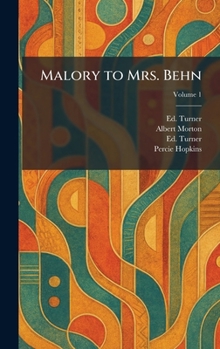
Malory to Mrs. Behn

"Malory to Mrs. Behn" is a foundational anthology of English prose that traces the stylistic and thematic evolution of the language from the late medieval period through the Restoration. This volume serves as a curated journey through the developmental milestones of narrative fiction, beginning with the chivalric and legendary tales of Sir Thomas Malory and concluding with the pioneering works of Aphra Behn, one of the first professional female writers in England.
The collection offers a broad perspective on the shifts in English culture, morality, and linguistic expression across more than two centuries. By juxtaposing the Arthurian romances that defined the 15th century with the sophisticated and often transgressive prose of the late 17th century, the work illustrates the transition from medieval ideals to the early modern sensibility. Readers will find examples of early realism, pastoral romance, and social observation that paved the way for the modern novel.
As an essential resource for students of literary history and enthusiasts of classic letters, "Malory to Mrs. Behn" provides historical context and aesthetic appreciation for the authors who shaped the English canon. It highlights the enduring power of prose to capture the spirit of its age while influencing generations of writers to come.
This work has been selected by scholars as being culturally important, and is part of the knowledge base of civilization as we know it. This work was reproduced from the original artifact, and remains as true to the original work as possible. Therefore, you may see the original copyright references, library stamps (as most of these works have been housed in our most important libraries around the world), and other notations in the work.
This work is in the public domain in the United States of America, and possibly other nations. Within the United States, you may freely copy and distribute this work, as no entity (individual or corporate) has a copyright on the body of the work.
As a reproduction of a historical artifact, this work may contain missing or blurred pages, poor pictures, errant marks, etc. Scholars believe, and we concur, that this work is important enough to be preserved, reproduced, and made generally available to the public. We appreciate your support of the preservation process, and thank you for being an important part of keeping this knowledge alive and relevant.
Customer Reviews
ThriftBooks ® and the ThriftBooks ® logo are registered trademarks of Thrift Books Global, LLC
