


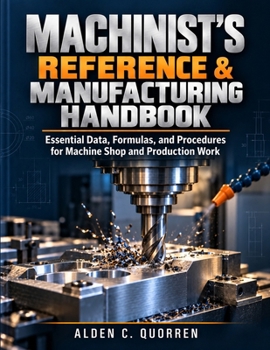
Machinist's Reference & Manufacturing Handbook: Essential Data, Formulas, and Procedures for Machine Shop and Production Work
No Customer Reviews

On the shop floor, a single job can call for selecting the right steel grade, calculating the correct spindle speed and feed rate, reading a geometric tolerance callout, and verifying the finished part with a precision instrument often within the same hour. Each of these tasks depends on accurate data and a sound procedure, and getting any one of them wrong can turn a careful setup into scrap. Machine shops and production floors run on numbers: material properties, cutting parameters, thread specifications, tolerance values, and inspection results. That information is frequently spread across multiple specialized texts and shortcuts picked up informally on the job, making it hard to find a reliable answer quickly or to be confident the number is right. This handbook addresses that problem directly, bringing the full range of machining and manufacturing data into one systematically organized reference that moves from foundational mathematics and materials through the core machining processes and into CNC programming, dimensional control, and shop safety. Each of the fifteen chapters opens with clear learning objectives and develops the subject through explanatory text, equations, data tables, and figures, followed by complete worked examples that show every intermediate step and unit conversion. Practice problems with a verified answer key follow each chapter, so the reader can confirm understanding before applying a method on an actual job. Working through this handbook, the reader will: Perform shop trigonometry, taper and bolt-circle calculations, and unit conversions with fully worked examples.Select and evaluate engineering materials by SAE/AISI and UNS designation, interpret mechanical-property test data, and apply heat-treatment and machinability principles.Read and apply geometric dimensioning and tolerancing callouts - feature control frames, datum reference frames, and tolerance-zone concepts - consistent with ASME Y14.5.Calculate cutting speed, feed, depth of cut, and machining time for turning, milling, drilling, reaming, and grinding, and select suitable cutting-tool materials and geometry.Program and verify CNC operations, including work-coordinate systems, tool offsets, and canned cycles.Cut, measure, and troubleshoot threads in both Unified Inch and ISO metric series, and work through gear mathematics and common gear-manufacturing processes.Apply precision measuring instruments, gage blocks, and coordinate measuring machines, with an introduction to process capability and statistical process control.Four quick-reference appendices put daily shop-floor data within easy reach: tap drill sizes for Unified and metric threads, decimal equivalents for fractional, wire-gage, and letter drill sizes, a hardness-conversion table, and recommended cutting speeds and feeds by material group and operation. Material designations follow the SAE/AISI and UNS systems, tolerancing follows ASME Y14.5, and United States customary units serve as the primary system, with metric equivalents provided wherever standard industry practice calls for them. This handbook is written for journeyman machinists working to close tolerances, CNC operators and programmers, manufacturing and process engineers specifying production work, toolmakers, quality and inspection technicians, and students building a foundation in machining and manufacturing technology - suited equally to sequential study and to quick lookup at the bench. Get your copy and discover a structured, standards-based approach to the mathematics, materials, processes, and procedures that define modern machining and production work.
Format:Paperback
Language:English
ISBN:B0HNDCHQY1
ISBN13:9798162994596
Release Date:October 2026
Publisher:Independently Published
Length:388 Pages
Weight:1.98 lbs.
Dimensions:0.8" x 8.5" x 11.0"
Customer Reviews
0 rating
Copyright © 2026 Thriftbooks.com
Terms of Use | Privacy Policy | Do Not Sell/Share My Personal Information | Cookie Notice | Cookie Preferences | Accessibility Statement
ThriftBooks ® and the ThriftBooks ® logo are registered trademarks of Thrift Books Global, LLC
ThriftBooks ® and the ThriftBooks ® logo are registered trademarks of Thrift Books Global, LLC
