


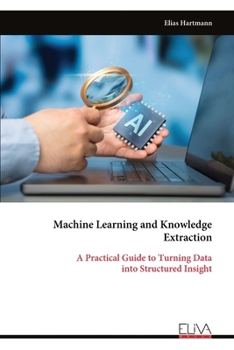
Machine Learning and Knowledge Extraction: A Practical Guide to Turning Data into Structured Insight
No Customer Reviews

Machine learning is often presented as a set of algorithms, while knowledge extraction is often presented as a set of information retrieval or data mining techniques. In practice, the two fields meet in operational systems that must transform records, documents, images, events, and conversations into knowledge that people can understand and use. This book treats knowledge extraction as a full process rather than a single model. The process begins with the definition of a question and ends with a maintained knowledge product: a classification, a summary, a knowledge graph, a decision rule, a searchable index, a report, or an interface used in daily work. The chapters move from conceptual foundations to project execution. They discuss data sources, representation, supervised and unsupervised learning, natural language processing, knowledge graphs, evaluation, interpretability, deployment, and governance. The approach is practical and interdisciplinary. It recognizes that technical performance is important, but that extracted knowledge must also be useful, auditable, fair, and explainable. A project that cannot be trusted or maintained cannot be considered successful, even if its model scores appear strong.
Format:Paperback
Language:English
ISBN:9999344712
ISBN13:9789999344715
Release Date:May 2026
Publisher:Eliva Press
Length:94 Pages
Weight:0.30 lbs.
Dimensions:0.2" x 6.0" x 9.0"
Customer Reviews
0 rating
Copyright © 2026 Thriftbooks.com
Terms of Use | Privacy Policy | Do Not Sell/Share My Personal Information | Cookie Policy | Cookie Preferences | Accessibility Statement
ThriftBooks ® and the ThriftBooks ® logo are registered trademarks of Thrift Books Global, LLC
ThriftBooks ® and the ThriftBooks ® logo are registered trademarks of Thrift Books Global, LLC
