


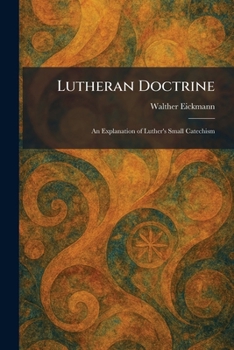
Lutheran Doctrine: An Explanation of Luther's Small Catechism

"Lutheran Doctrine: An Explanation of Luther's Small Catechism" serves as a comprehensive and accessible guide to the foundational tenets of the Lutheran faith. Authored by Walther Eickmann, this work provides a systematic breakdown of the core teachings established by Martin Luther, designed to assist both students and laypeople in understanding the essential elements of Christian belief and practice.
The book delves into the Six Chief Parts of the catechism: the Ten Commandments, the Apostles' Creed, the Lord's Prayer, the Sacrament of Holy Baptism, Confession, and the Sacrament of the Altar. Eickmann's exposition clarifies complex theological concepts through clear language and scriptural references, emphasizing the historical and spiritual significance of the Lutheran tradition. By bridging the gap between historical doctrine and contemporary understanding, this volume remains a valuable resource for anyone seeking a deeper grasp of Lutheran theology and the Small Catechism.
Ideal for personal study or classroom instruction, "Lutheran Doctrine" highlights the enduring relevance of Luther's work in shaping Protestant thought. It explores themes of grace, faith, and the sacraments, offering readers a robust framework for spiritual reflection and doctrinal clarity.
This work has been selected by scholars as being culturally important, and is part of the knowledge base of civilization as we know it. This work was reproduced from the original artifact, and remains as true to the original work as possible. Therefore, you may see the original copyright references, library stamps (as most of these works have been housed in our most important libraries around the world), and other notations in the work.
This work is in the public domain in the United States of America, and possibly other nations. Within the United States, you may freely copy and distribute this work, as no entity (individual or corporate) has a copyright on the body of the work.
As a reproduction of a historical artifact, this work may contain missing or blurred pages, poor pictures, errant marks, etc. Scholars believe, and we concur, that this work is important enough to be preserved, reproduced, and made generally available to the public. We appreciate your support of the preservation process, and thank you for being an important part of keeping this knowledge alive and relevant.
Customer Reviews
ThriftBooks ® and the ThriftBooks ® logo are registered trademarks of Thrift Books Global, LLC
