


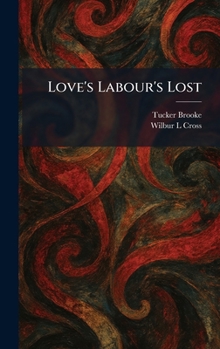
Love's Labour's Lost

"Love's Labour's Lost" is one of William Shakespeare's most witty and linguistically playful early comedies. The story follows the King of Navarre and his three loyal lords as they commit to a three-year oath of asceticism, scholarly study, and the complete avoidance of women. However, their vow is immediately challenged by the diplomatic arrival of the Princess of France and her charming attendants. What follows is a spirited battle of the sexes, filled with elaborate courtship rituals, poetic exchanges, and humorous miscommunications.
The play is celebrated for its sophisticated use of language, featuring parodies of various contemporary literary styles and intellectual pedantry. Through its cast of colorful supporting characters-including the fantastical Spaniard Don Adriano de Armado and the pedantic schoolmaster Holofernes-Shakespeare satirizes the excesses of rhetoric and the follies of courtly love. Distinct from many of his other comedies, "Love's Labour's Lost" concludes with an unexpected twist that brings a touch of realism to its otherwise whimsical proceedings. This work stands as a brilliant testament to Shakespeare's mastery of dialogue and his keen insight into the human heart's resistance to artificial constraints.
This work has been selected by scholars as being culturally important, and is part of the knowledge base of civilization as we know it. This work was reproduced from the original artifact, and remains as true to the original work as possible. Therefore, you may see the original copyright references, library stamps (as most of these works have been housed in our most important libraries around the world), and other notations in the work.
This work is in the public domain in the United States of America, and possibly other nations. Within the United States, you may freely copy and distribute this work, as no entity (individual or corporate) has a copyright on the body of the work.
As a reproduction of a historical artifact, this work may contain missing or blurred pages, poor pictures, errant marks, etc. Scholars believe, and we concur, that this work is important enough to be preserved, reproduced, and made generally available to the public. We appreciate your support of the preservation process, and thank you for being an important part of keeping this knowledge alive and relevant.
Customer Reviews
ThriftBooks ® and the ThriftBooks ® logo are registered trademarks of Thrift Books Global, LLC
