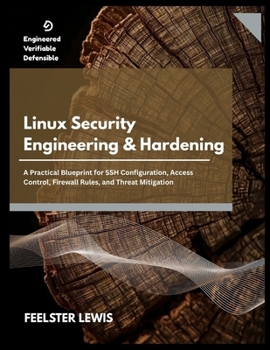
Linux Security Engineering & Hardening: A Practical Blueprint for SSH Configuration, Access Control, Firewall Rules, and Threat Mitigation
No Customer Reviews

Linux Security Engineering & Hardening is a practitioner's blueprint for engineers who are accountable for production Linux systems and who must be able to explain, test, and defend every control they apply. Rather than offering a catalogue of settings, it walks through the decisions that precede configuration and the verification that follows it. The book begins with threat modelling, asset inventory, and the change discipline that keeps a baseline accurate over time. It then builds outward through host baseline, identity and privilege management, SSH architecture, key lifecycle, network filtering, filesystem and mandatory access control, service isolation, threat mitigation, logging and detection, incident response, and the governance practices that hold a programme together across staff changes. Each subchapter states a principle, gives the configuration that implements it, describes the verification that proves it is in force, and names the failure modes that produce a system which appears hardened and is not. Benefits of Owning This Book You gain a repeatable method rather than a checklist, so hardening survives upgrades, migrations, and staff turnover. You learn to read effective configuration instead of edited files, which is the difference between believing a control is in force and proving it. You acquire verification commands that satisfy an auditor, an incident responder, and a colleague asking why a setting exists. You get explicit sequencing guidance that prevents self-inflicted lockouts during SSH, PAM, and firewall changes. You also receive a control-record structure that makes evidence a byproduct of operations instead of a project before an audit. Practical Solutions You Will Use Immediately Configure SSH algorithm families explicitly and confirm the result with the daemon's effective-configuration output rather than the file you edited. Replace standing privilege with short-lived certificates carrying principals, forced commands, and source restrictions so access expires without intervention. Build an nftables ruleset as a single atomic file with a default-deny policy, a stateful rule placed first, and a rate-limited log entry that produces evidence without flooding storage. The book also shows how to harden an ordinary systemd service using sandboxing directives measured by its own exposure score, how to enumerate every persistence surface including timers and user-level units, and how to close an incident with a timeline, quantified gaps, and actions that carry owners and tests.
Format:Paperback
Language:English
ISBN:B0HNQXXNFB
ISBN13:9798164082994
Release Date:October 2026
Publisher:Independently Published
Length:164 Pages
Weight:0.87 lbs.
Dimensions:0.3" x 8.5" x 11.0"
Customer Reviews
0 rating
Copyright © 2026 Thriftbooks.com
Terms of Use | Privacy Policy | Do Not Sell/Share My Personal Information | Cookie Notice | Cookie Preferences | Accessibility Statement
ThriftBooks ® and the ThriftBooks ® logo are registered trademarks of Thrift Books Global, LLC
ThriftBooks ® and the ThriftBooks ® logo are registered trademarks of Thrift Books Global, LLC