


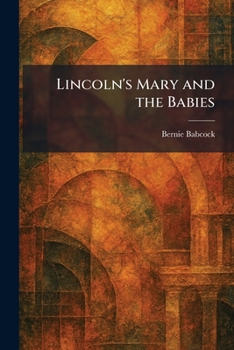
Lincoln's Mary and the Babies

Select Format
Select Condition 
Book Overview
"Lincoln's Mary and the Babies" offers an intimate and poignant look into the private life of one of America's most complex historical figures, Mary Todd Lincoln. Written by Bernie Babcock, a dedicated chronicler of the Lincoln family, this work shifts the focus from the political battlefield to the domestic sphere, exploring Mary's role as a devoted mother and the wife of Abraham Lincoln during their years in Springfield and the White House.
The narrative delves into the joys and sorrows of the Lincoln household, providing a tender portrayal of the Lincoln children-Robert, Eddie, Willie, and Tad. Babcock highlights the maternal instincts and emotional resilience of a woman often misunderstood by history, illustrating the deep bonds that sustained the family through personal tragedy and national crisis. By emphasizing the human side of the Great Emancipator's family life, the book serves as both a historical character study and a touching exploration of 19th-century parenthood. "Lincoln's Mary and the Babies" remains a valuable resource for readers interested in the personal history of the Lincoln family and the social landscape of mid-19th century America.
This work has been selected by scholars as being culturally important, and is part of the knowledge base of civilization as we know it. This work was reproduced from the original artifact, and remains as true to the original work as possible. Therefore, you may see the original copyright references, library stamps (as most of these works have been housed in our most important libraries around the world), and other notations in the work.
This work is in the public domain in the United States of America, and possibly other nations. Within the United States, you may freely copy and distribute this work, as no entity (individual or corporate) has a copyright on the body of the work.
As a reproduction of a historical artifact, this work may contain missing or blurred pages, poor pictures, errant marks, etc. Scholars believe, and we concur, that this work is important enough to be preserved, reproduced, and made generally available to the public. We appreciate your support of the preservation process, and thank you for being an important part of keeping this knowledge alive and relevant.
Customer Reviews
ThriftBooks ® and the ThriftBooks ® logo are registered trademarks of Thrift Books Global, LLC
