


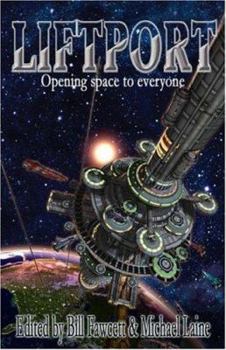
Liftport - The Space Elevator: Opening Space to Everyone


Seen as merely a thought experiment for over a century, the space elevator is now understood to be achievable in our foreseeable future. It promises to open up the Solar System to all of humanity, and... This description may be from another edition of this product.
Format:Paperback
Language:English
ISBN:1592221092
ISBN13:9781592221097
Release Date:June 2006
Publisher:Meisha Merlin Publishing, Inc.
Length:350 Pages
Weight:0.95 lbs.
Dimensions:8.0" x 0.8" x 5.0"
Customer Reviews
5 ratings
Love it!
Published by Thriftbooks.com User , 19 years ago
I love this book. I'm interested in space projects and science fiction. This was a great combination of fact and fiction. Both informative and entertaining. It's great for the laymen. You don't need to know much about space technology to understand and enjoy this book.
Doorway to planets and stars
Published by Thriftbooks.com User , 19 years ago
A terrific overview of the various steps needed to build the space elevator. Can't wait to see it happen. Hope it's soon.
A project to change our future
Published by Thriftbooks.com User , 20 years ago
This collection of fact and fiction centers on the proposal by a startup company, Liftport, to create a new way to get into space: an elevator. The idea is not new, and the specific means they propose to do it has been discussed in technical papers; nevertheless this is likely the first popularly accessible book that describes the new near-term practicalities of construction, operation, and business for such a system. Liftport plans to get their first elevator up and running before 2020, and this book describes how they may just be able to do that. The format of the book is a collection of independent essays (the factual portions) and stories, some of which are reprinted from separate novels (by Arthur C. Clarke, David Brin, and Charles Sheffield) and the rest seem to have been specifically written for this collection. The quality of the fiction is rather variable; unfortunately some of the authors would perhaps have benefited from reading the technical sections, as some details are rather jarringly wrong. For example, the "Hermit of the Skies" would not plummet and burn up from the top station, but would be thrown out away from the planet - that's sort of the whole point. In "High Space", you can't be in orbit 300 miles above Earth's surface and stay over one spot - you have to be going a lot slower than orbital speeds. And the troposphere is the lowermost portion of Earth's atmosphere, not what you would hit first on the way down! But of course the technical details aren't the central point of the stories, so maybe it's silly to be picky about it. The longest fiction section, "The Rings of Earth", by William H. Keith, is among the best of the contributed stories. The vision it paints, of a future Earth-bound society knowing of "gods" above, and the stunning reality of the ending, is almost worth the price of the whole book. The technical essays describe the project in good detail, though somewhat redundantly and at different levels. It would have helped if the editors had given the authors a better picture of what the other parts of the book would cover. I wrote (and donated) one of those essays, so I'm somewhat familiar with the way it worked - I have met a number of the authors in person as well. The elevator physically consists of an anchor station on Earth's surface, a counterweight beyond geosynchronous orbit in space, and a strong ribbon connecting the two. A "lifter" climbs the ribbon; technical essays cover each of those components. Additionally, power to the lifter must be supplied without physical contact which would add precious mass - a power beaming system is described that could do the job. Construction steps and safety issues are also discussed. The remaining essays discuss business, law, and political issues more than technology. How the elevator will make money, what it will do to the space launch business, is covered in several chapters. Who will have legal jurisdiction is one central question - from these essays it see
Interesting, even for a casual reader
Published by Thriftbooks.com User , 20 years ago
I have no science degree and spend little time pondering space elevators, but the subject is interesting and this book is well organized. Different authors took specific topics and created one or two chapters each. Famous sames such as Kim Stanley Robinson contributed. I received this as a present prior to a week at the beach and enjoyed the book more than expected, flipping to chapters that interested me and skipping others. By coincidence, I visited the Wright Brothers' museum near Kitty Hawk while on vacation. It is striking how rapidly air travel developed from the "cranks and weirdos" stage around 1900 to a substantive business. I do not know if the analogy translates, but you never know.
The roadmap to our future
Published by Thriftbooks.com User , 20 years ago
Seen as merely a thought experiment for over a century, the space elevator is now understood to be achievable in our foreseeable future. It promises to open up the Solar System to all of humanity, and this book gives you a peek at that future. Interweaving both science fiction stories involving the space elevator along with non-fiction articles on the basic technical, financial, legal, social and political issues surrounding the space elevator, this book will give you an entertaining and informative crash course in the space elevator. After reading this book, you will understand both why we want to build a space elevator as well as how it will be built.
Copyright © 2026 Thriftbooks.com
Terms of Use | Privacy Policy | Do Not Sell/Share My Personal Information | Cookie Notice | Cookie Preferences | Accessibility Statement
ThriftBooks ® and the ThriftBooks ® logo are registered trademarks of Thrift Books Global, LLC
ThriftBooks ® and the ThriftBooks ® logo are registered trademarks of Thrift Books Global, LLC
