


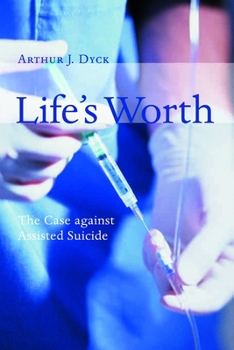
Life's Worth: The Case Against Assisted Suicide

Select Format
Select Condition 
Book Overview
Mary Shivanandan
"Meticulously taking apart the arguments in favor of euthanasia and physician-assisted suicide, Arthur Dyck shows how, ultimately, they undermine the very basis of human community. He brilliantly defends the 700-year-old Anglo-American tradition of law favoring life, which depends equally on the rights tradition of Hobbes and Locke and the Christian belief in humanity made in God's image. Enriched with anecdotes and sociological research, this concise, clearly written book is invaluable for experts and general readers alike."
"Meticulously taking apart the arguments in favor of euthanasia and physician-assisted suicide, Arthur Dyck shows how, ultimately, they undermine the very basis of human community. He brilliantly defends the 700-year-old Anglo-American tradition of law favoring life, which depends equally on the rights tradition of Hobbes and Locke and the Christian belief in humanity made in God's image. Enriched with anecdotes and sociological research, this concise, clearly written book is invaluable for experts and general readers alike."
Format:Paperback
Language:English
ISBN:0802845940
ISBN13:9780802845948
Release Date:November 2002
Publisher:William B. Eerdmans Publishing Company
Length:120 Pages
Weight:0.50 lbs.
Dimensions:0.4" x 6.4" x 9.4"
Related Subjects
Christian Books & Bibles Death & Grief Ethics Ethics & Morality Health, Fitness & Dieting Health, Fitness & Dieting Medical Medical Books Medical Ethics Medicine Philosophy Politics & Social Sciences Psychology & Counseling Religion Religion & Spirituality Religious Studies Suicide TheologyCustomer Reviews
1 rating
A Worth-while Book
Published by Thriftbooks.com User , 23 years ago
"There is a solid moral and practical basis for the laws against assisted suicide that now exist," argues the author. This brief volume (110 pages) seeks to make that case.In this book, Dyck, a Population Ethics professor at Harvard university, examines the various legal and philosophical arguments thrown up in favor of physician-assisted suicide (PAS), assesses different types of treatment available for the suffering and terminally ill, establishes the religious and moral framework which upholds the sanctity of life, and concludes with a look at Christian concerns over sickness and dying.On the philosophical front, Dyck details recent defenses of PAC, and shows how major moral and philosophical shifts have taken place to allow such defenses to take root and flourish. A major shift in how we view human nature undergirds much of the euthanasia debate today. That is, we have shifted from an emphasis on the sacredness of human life to autonomy as the highest good.For example, thinkers such as Hobbes, Locke and Kant understood human nature as including a strong sense of self-preservation, not just of the species, but of one's self. Mill, on the other hand, adopted an autonomous hedonism: self-happiness is the goal, regardless of how that is played out. Unfortunately, the thinking of Mill and others has tended to win out over the traditional view.That, coupled with the rise of secularism and the collapse of religion, has led to a quality of life ethic replacing the sanctity of life ethic. These differing views of human nature and the social good underlie the differences found in the euthanasia debate today.These differences take practical expression when we decide whether to utilise palliative care or simply administer a lethal injection. The two different actions reflect two different views of humanity. Dyck's second chapter examines the moral differences between comfort-only care and PAS. While there may be some overlap (pain relief can hasten death), the two are quite different in moral terms.A major difference has to do with intent. What is the primary goal: to preserve life, or to end it? A lethal agent is introduced into the latter, making it ethically very different indeed.Chapter three deals with moral rights and human right in the PAS debate. Traditionally it was held that we all have a moral responsibility to preserve life - others and our own. Suicide (and PAS) thus was seen as an abrogation of that central moral responsibility. Counter-arguments about autonomy and freedom of choice do not however curtail that responsibility, argues Dyck. The over-emphasis on choice and freedom may sound good, but it often leads to disastrous outcomes.That is, what a society allows intellectually, and more importantly, legally, will impact on how individuals respond to those conditions. One study found, for example, that not one AIDS patients in England who wanted to end their life did so, while 30 % did in the Netherlands. The reason? PAS is illegal in Eng
Copyright © 2026 Thriftbooks.com
Terms of Use | Privacy Policy | Do Not Sell/Share My Personal Information | Cookie Notice | Cookie Preferences | Accessibility Statement
ThriftBooks ® and the ThriftBooks ® logo are registered trademarks of Thrift Books Global, LLC
ThriftBooks ® and the ThriftBooks ® logo are registered trademarks of Thrift Books Global, LLC
