Skip to content
Scan a barcode
Scan
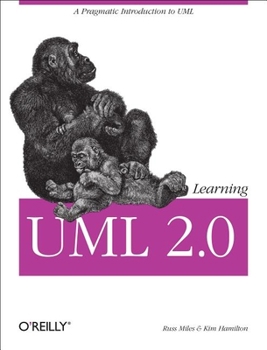
Paperback Learning UML 2.0: A Pragmatic Introduction to UML Book

ISBN: B00CVDUJW8

ISBN13: 9780596009823

Learning UML 2.0: A Pragmatic Introduction to UML

"Since its original introduction in 1997, the Unified Modeling Language has revolutionized software development. Every integrated software development environment in the world--open-source, standards-based, and proprietary--now supports UML and, more importantly, the model-driven approach to software development. This makes learning the newest UML standard, UML 2.0, critical for all software developers--and there isn't a better choice than this clear, step-by-step guide to learning the language."
--Richard Mark Soley, Chairman and CEO, OMG

If you're like most software developers, you're building systems that are increasingly complex. Whether you're creating a desktop application or an enterprise system, complexity is the big hairy monster you must manage.


The Unified Modeling Language (UML) helps you manage this complexity. Whether you're looking to use UML as a blueprint language, a sketch tool, or as a programming language, this book will give you the need-to-know information on how to apply UML to your project. While there are plenty of books available that describe UML, Learning UML 2.0 will show you how to use it. Topics covered include:


Capturing your system's requirements in your model to help you ensure that your designs meet your users' needs

Modeling the parts of your system and their relationships

Modeling how the parts of your system work together to meet your system's requirements

Modeling how your system moves into the real world, capturing how your system will be deployed

Engaging and accessible, this book shows you how to use UML to craft and communicate your project's design. Russ Miles and Kim Hamilton have written a pragmatic introduction to UML based on hard-earned practice, not theory. Regardless of the software process or methodology you use, this book is the one source you need to get up and running with UML 2.0. Additional information including exercises can be found at www.learninguml2.com.


Russ Miles is a software engineer for General Dynamics UK, where he works with Java and Distributed Systems, although his passion at the moment is Aspect Orientation and, in particular, AspectJ. Kim Hamilton is a senior software engineer at Northrop Grumman, where she's designed and implemented a variety of systems including web applications and distributed systems, with frequent detours into algorithms development.

Recommended

Format: Paperback

Condition: New

$35.19
Save $19.80!
List Price $54.99
Ships within 2-3 days
Save to List

Customer Reviews

5 ratings

Good overview of UML 2.0

I was looking for a way to present to a reviewing committee an educational video game which I am designing. "Learning UML 2.0" was at the right level of detail to show me what diagram types I might use. The book is right for a person who taken a course in Java or C++ where you do many small problems, and now you need a plan for outlining a larger project. I think the book would be very difficult for anyone who had not programmed in Java or C++. Many years ago I had vacillated among the notations of Rumbaugh, Booch and Jacobson. It is satisfying to see their ideas combined in a common notation. Reading this book before and during an object-oriented design project will alert you to problems before they become errors.

Best UML book for beginner

I've read a couple of other books that talk about UML, but they seem to just skim the surface and try to talk simple to you. This book is truly for someone who wants to learn about UML and how to use it properly. I recommend reading through the whole book once quickly and then go back and read it again carefully. I believe that's the best way to learn the details presented in this book.

Pragmatic UML

I found the presentation pragmatic, readable, and practical. It is easy to pick a UML Diagram type you want to use and start reading, drawing. UML is a straight forward notation and these authors presents it as such. (Perhaps because it is straight forward many other authors seem to make their UML exposition much more complex than it needs to be).

Excellent Book. 2 thums up !!

Excellent book. Entertaining, not distracting with formal details or innecessary stuff that only appears in the UML specification. This book will give you excellent practical insight on the stuff that matters in the day to day development using UML.

Good conversational approach that builds on itself...

Based on a recent project at work, I realized I needed a better understanding of UML. To that end, I decided to review the book Learning UML 2.0 by Russ Miles and Kim Hamilton. While there's still a lot to learn there, I think I have a much better grasp on what's going on... Contents: Introduction; Modeling Requirements - Use Cases; Modeling System Workflows - Activity Diagrams; Modeling a System's Logical Structure - Introducing Classes and Class Diagrams; Modeling a System's Logical Structure - Advanced Class Diagrams; Bringing Your Classes to Life - Object Diagrams; Modeling Ordered Interactions - Sequence Diagrams; Focusing on Interaction Links - Communication Diagrams; Focusing on Interaction Timing - Timing Diagrams; Completing the Interaction Picture - Interaction Overview Diagrams; Modeling a Class's Internal Structure - Composite Structures; Managing and Reusing Your System's Parts - Component Diagrams; Organizing Your Model - Packages; Modeling an Object's State - State Machine Diagrams; Modeling Your Deployed System - Deployment Diagrams; Object Constraint Language; Adapting UML - Profiles; A History of UML; Index Miles and Hamilton use a conversational approach to introduce the reader to UML 2.0, and they build on a model that makes sense. The Use Case view drives nearly everything, as that's the "what" of what the system is supposed to be able to do. Then they cover the logical, process, physical, and development views that support the system and show different perspectives of what the system will look like depending on which angle you view it from. All too often, it seems like UML diagrams are just thrown at the reader one after another, and there's no real explanation as to how it all fits together. Fortunately, that's not the case here, as the model framework for their tutorial puts everything in the right relationship to each other. I also appreciated how the diagram tutorials started out with just the basics and built from there. Again, it's common to see a tutorial diagram with every possible permutation thrown in right at the start. As such, it's far too easy to zone out right away because of all the baggage. Here, you get the core elements of the diagram first (which often cover 80 - 90% of what you need to know anyway), and then the extra details are introduced after that. I was much better able to conceptualize the whole discussion when put in that light... Very nice job... I would say that if you have this book coupled with a full UML 2.0 reference manual of some sort, you'd be pretty well set to do most anything you'd need to in the world of UML. I know I'm better equipped to do those sequence diagrams now, where before I was faking it pretty well... :)
Copyright © 2026 Thriftbooks.com Terms of Use | Privacy Policy | Do Not Sell/Share My Personal Information | Cookie Notice | Cookie Preferences | Accessibility Statement
ThriftBooks ® and the ThriftBooks ® logo are registered trademarks of Thrift Books Global, LLC

GoDaddy Verified and Secured