


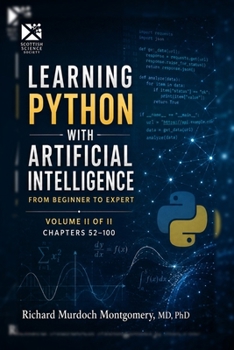
Learning Python with Artificial Intelligence Volume II of II: From Beginner to Expert
No Customer Reviews

Volume II continues the apprenticeship begun in Volume I. It starts where a learner who can write
small Python programmes must begin to negotiate with the world outside a single file: networks, data
stores, automation, applications, professional risks, scientific computation, agents, repositories, and
systems that must remain understandable after their first successful run.
Chapters 52-72 extend Python into web and data work, then turn the same language upon the
educational relationship with artificial intelligence. The learner meets a tutor, exercise generator,
examiner, debugger, reviewer, refactoring assistant, documentation translator, and pair programmer.
The governing question is not whether an AI system can produce a plausible answer. It is whether the
learner can predict, execute, verify, and explain the result.
Chapters 73-92 mark the passage from protected apprenticeship to independent programming and
then to agentic Python. Algorithms, performance, concurrency, object design, internals, scientific
computing, machine learning, repositories, multi-agent workflows, and capstone projects are treated as
accountable practices. Each presentation page states the chapter's purpose, boundary, contents, learning
aims, and reason for care before the technical work begins.
Chapters 93-100 enter expert practice. Large projects, source reading, professional review, teaching,
research, domain work, lifelong learning, and independence are not presented as a ceremonial
graduation. They are recurring forms of responsibility. The appendices, conclusion, glossary,
bibliography, and Index of words remain part of the same continuous manuscript, so that the reader can
move from an idea to a procedure, from a procedure to evidence, and from evidence back to a better
question.
The volume is therefore best read actively. Write the prediction before asking for assistance. Keep
the smallest test that could change your mind. Treat an elegant explanation as a proposal until the
programme, the calculation, or the record supports it. The machine may accelerate the apprenticeship; it
cannot own the understanding.What changes in Volume II
Volume II is not simply a longer list of Python topics. It is a change in the scale and moral
temperature of the work. A programme now speaks across a network, writes to a database, modifies a
repository, controls a workflow, or supports a decision made by another person. The technical act
remains important, but it is no longer sufficient. The learner must name the boundary, the authority, the
failure route, and the evidence by which success will be recognised.
How to read the chapters
Every chapter opens with a presentation page. Read it as a contract rather than as advertising: it
identifies the chapter's contents, what the learner should be able to do, and why the material matters.
The body then alternates explanation, equations, code, diagrams, worked examples, exercises, and
direction checks. The recurring discipline is deliberate: predict first, use AI within a declared boundary,
execute the smallest useful test, inspect the result, and explain what the evidence does and does not
show.
The scale of responsibility
The later chapters do not ask the learner to become suspicious of every tool. They ask for a better
distinction between assistance and authority. An AI system may propose a query, a test, a refactoring, a
review finding, a retrieval result, a plan, or a patch. The learner still decides whether the proposal is
relevant, safe, supported, reversible, and understood. That is why the volume returns so often to
provenance, tests, permissions, rollback, explain-back, and the right to abstain.
small Python programmes must begin to negotiate with the world outside a single file: networks, data
stores, automation, applications, professional risks, scientific computation, agents, repositories, and
systems that must remain understandable after their first successful run.
Chapters 52-72 extend Python into web and data work, then turn the same language upon the
educational relationship with artificial intelligence. The learner meets a tutor, exercise generator,
examiner, debugger, reviewer, refactoring assistant, documentation translator, and pair programmer.
The governing question is not whether an AI system can produce a plausible answer. It is whether the
learner can predict, execute, verify, and explain the result.
Chapters 73-92 mark the passage from protected apprenticeship to independent programming and
then to agentic Python. Algorithms, performance, concurrency, object design, internals, scientific
computing, machine learning, repositories, multi-agent workflows, and capstone projects are treated as
accountable practices. Each presentation page states the chapter's purpose, boundary, contents, learning
aims, and reason for care before the technical work begins.
Chapters 93-100 enter expert practice. Large projects, source reading, professional review, teaching,
research, domain work, lifelong learning, and independence are not presented as a ceremonial
graduation. They are recurring forms of responsibility. The appendices, conclusion, glossary,
bibliography, and Index of words remain part of the same continuous manuscript, so that the reader can
move from an idea to a procedure, from a procedure to evidence, and from evidence back to a better
question.
The volume is therefore best read actively. Write the prediction before asking for assistance. Keep
the smallest test that could change your mind. Treat an elegant explanation as a proposal until the
programme, the calculation, or the record supports it. The machine may accelerate the apprenticeship; it
cannot own the understanding.What changes in Volume II
Volume II is not simply a longer list of Python topics. It is a change in the scale and moral
temperature of the work. A programme now speaks across a network, writes to a database, modifies a
repository, controls a workflow, or supports a decision made by another person. The technical act
remains important, but it is no longer sufficient. The learner must name the boundary, the authority, the
failure route, and the evidence by which success will be recognised.
How to read the chapters
Every chapter opens with a presentation page. Read it as a contract rather than as advertising: it
identifies the chapter's contents, what the learner should be able to do, and why the material matters.
The body then alternates explanation, equations, code, diagrams, worked examples, exercises, and
direction checks. The recurring discipline is deliberate: predict first, use AI within a declared boundary,
execute the smallest useful test, inspect the result, and explain what the evidence does and does not
show.
The scale of responsibility
The later chapters do not ask the learner to become suspicious of every tool. They ask for a better
distinction between assistance and authority. An AI system may propose a query, a test, a refactoring, a
review finding, a retrieval result, a plan, or a patch. The learner still decides whether the proposal is
relevant, safe, supported, reversible, and understood. That is why the volume returns so often to
provenance, tests, permissions, rollback, explain-back, and the right to abstain.
Format:Paperback
Language:English
ISBN:B0HD7682D3
ISBN13:9798191104461
Release Date:August 2026
Publisher:Independently Published
Length:498 Pages
Weight:1.45 lbs.
Dimensions:1.0" x 6.0" x 9.0"
Customer Reviews
0 rating
Copyright © 2026 Thriftbooks.com
Terms of Use | Privacy Policy | Do Not Sell/Share My Personal Information | Cookie Policy | Cookie Preferences | Accessibility Statement
ThriftBooks ® and the ThriftBooks ® logo are registered trademarks of Thrift Books Global, LLC
ThriftBooks ® and the ThriftBooks ® logo are registered trademarks of Thrift Books Global, LLC
