


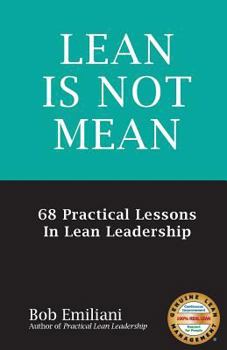
Lean Is Not Mean: 68 Practical Lessons in Lean Leadership

Lean Is Not Mean rests on a simple reality: the moment Lean is used to squeeze people, cut corners, or win at others' expense, it stops being Lean at all. Drawing on essays refined over years of teaching and practice, The book gives readers 68 short, pointed lessons to close the gap between how Lean is usually led - good for shareholders, bad for everyone else - and how it's meant to be led: A win-win, human-centered system that benefits employees, suppliers, customers, and communities alike.
Rather than a handful of chapters, the book delivers 68 standalone lessons that cluster around a few core pain points. This book helps readers by:
Reclaiming "Respect for People." A large group of lessons restores the half of Lean that executives routinely ignore or drop, showing that continuous improvement without genuine respect for people is "Fake Lean," and why fair, moral, win-win business is the whole point. Correcting How Leaders Actually Lead Lean. Many lessons target faulty thinking and decision-making, leadership variation, and the executive habit of mistaking a little Lean knowledge for deep understanding, offering the mindset shift that separates real Lean leaders from its many imitators. Exposing Fake Lean in All Its Forms. A recurring thread diagnoses Fake Lean across business, government, and healthcare, from tool obsessions, bureaucratic Lean, and the uncomfortable truth that "Fake Lean" sells a lot better than "Real Lean" - so readers can tell the real thing from the imitation. Fixing The Fundamentals of Flow. Several lessons sharpen the reader's grasp of what makes flow production different from batch-and-queue production, how managers themselves become queues, and how everyday leadership behaviors disrupt material and information flow. Confronting The Human and Economic Stakes. Other lessons make the human case for Lean, connect it to worker health and dignity, and show how it helps organizations survive low-growth, high-competition economies without resorting to "mean" cost-cutting and layoffs that harm people. Turning Insight into Daily Practice. A cluster of lessons emphasizes homework, daily practice, better genba walks, and sustaining Lean over time, converting philosophy into repeatable leadership habits, capped by appendices recounting the author's own Lean journey and the early history of Lean at Pratt & Whitney.
Punchy and often provocative, each lesson is short enough to read in a sitting yet pointed enough to change how a leader thinks. For managers and executives who sense their Lean efforts have drifted from achieving meaningful business results, this book is a course correction, a moral compass, a reminder that Lean, done right, should leave everyone better off.
Customer Reviews
ThriftBooks ® and the ThriftBooks ® logo are registered trademarks of Thrift Books Global, LLC
