


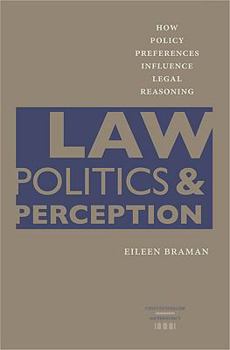
Law, Politics, & Perception: How Policy Preferences Influence Legal Reasoning
(Part of the Constitutionalism and Democracy Series)
No Customer Reviews

Are judges' decisions more likely to be based on personal inclinations or legal authority? The answer, Eileen Braman argues, is both. Law, Politics, and Perception brings cognitive psychology to bear on the question of the relative importance of norms of legal reasoning versus decision markers' policy preferences in legal decision-making. While Braman acknowledges that decision makers' attitudes--or, more precisely, their preference for policy outcomes--can play a significant role in judicial decisions, she also believes that decision-makers' belief that they must abide by accepted rules of legal analysis significantly limits the role of preferences in their judgements. To reconcile these competing factors, Braman posits that judges engage in "motivated reasoning," a biased process in which decision-makers are unconsciously predisposed to find legal authority that is consistent with their own preferences more convincing than those that go against them. But Braman also provides evidence that the scope of motivated reasoning is limited. Objective case facts and accepted norms of legal reasoning can often inhibit decision makers' ability to reach conclusions consistent with their preferences.
Format:Hardcover
Language:English
ISBN:081392829X
ISBN13:9780813928296
Release Date:October 2009
Publisher:University of Virginia Press
Length:256 Pages
Weight:1.15 lbs.
Dimensions:1.0" x 6.3" x 9.4"
Grade Range:Postsecondary and higher
Customer Reviews
0 rating
Copyright © 2026 Thriftbooks.com
Terms of Use | Privacy Policy | Do Not Sell/Share My Personal Information | Cookie Policy | Cookie Preferences | Accessibility Statement
ThriftBooks ® and the ThriftBooks ® logo are registered trademarks of Thrift Books Global, LLC
ThriftBooks ® and the ThriftBooks ® logo are registered trademarks of Thrift Books Global, LLC
