


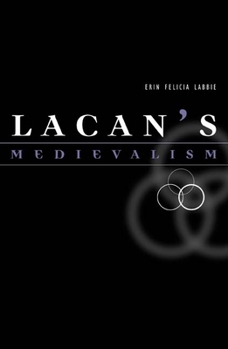
Lacan's Medievalism
No Customer Reviews

One of the foundational premises of Jacques Lacan's psychoanalytical project was that the history of philosophy concealed the history of desire, and one of the goals of his work was to show how desire is central to philosophical thinking.In Lacan's Medievalism, Erin Felicia Labbie demonstrates how Lacan's theory of desire is bound to his reading of medieval texts. She not only alters the relationship between psychoanalysis and medieval studies, but also illuminates the ways that premodern and postmodern epochs and ideologies share a concern with the subject, the unconscious, and language, thus challenging notions of strict epistemological cuts. Lacan's psychoanalytic work contributes to the medieval debate about universals by revealing how the unconscious relates to the category of the real. By analyzing the systematic adherence to dialectics and the idealization of the hard sciences, Lacan's Medievalism asserts that we must take into account the play of language and desire within the unconscious and literature in order to understand the way that we know things in the world and the manner in which order is determined.Erin Felicia Labbie is assistant professor of English at Bowling Green State University.
Format:Paperback
Language:English
ISBN:0816645167
ISBN13:9780816645169
Release Date:September 2006
Publisher:University of Minnesota Press
Length:288 Pages
Weight:0.86 lbs.
Dimensions:0.6" x 6.1" x 9.0"
Customer Reviews
0 rating
Copyright © 2026 Thriftbooks.com
Terms of Use | Privacy Policy | Do Not Sell/Share My Personal Information | Cookie Policy | Cookie Preferences | Accessibility Statement
ThriftBooks ® and the ThriftBooks ® logo are registered trademarks of Thrift Books Global, LLC
ThriftBooks ® and the ThriftBooks ® logo are registered trademarks of Thrift Books Global, LLC
