


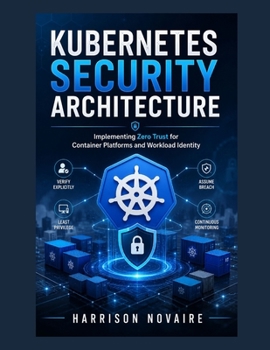
Kubernetes Security Architecture: Implementing Zero Trust for Container Platforms and Workload Identity
No Customer Reviews

A single compromised pod can become a full-cluster breach in minutes. Most Kubernetes clusters are one flat network, one auto-mounted service account token, and one missing admission policy away from exactly that. This book builds the architecture that changes all three defaults - layer by layer, with working YAML, real CLI output, and a verification step in every chapter. Kubernetes Security Architecture is a chapter-by-chapter implementation guide for platform engineers who need to move from default-allow networking and shared service accounts to a documented, defensible zero-trust posture. Unlike books that deliver conceptual frameworks with no code, or tool guides with no architectural reasoning, this book bridges both: the threat model behind every control and the specific configuration that makes it real. What you will be able to do after reading this book: - Harden the Kubernetes control plane by encrypting etcd at rest, denying anonymous API server access, and shipping audit logs off-node before an incident
- Design RBAC with least-privilege role bindings, automated drift detection, and a nightly snapshot-to-Git process that alerts on unexpected permission changes
- Deploy SPIFFE and SPIRE workload identity to replace long-lived service account tokens with short-lived, cryptographically attested SVIDs that expire in minutes
- Configure KMS-backed secrets encryption and automated rotation using External Secrets Operator and HashiCorp Vault dynamic credentials
- Apply default-deny NetworkPolicy and Cilium Layer 7 microsegmentation to stop east-west lateral movement before it starts
- Enforce mutual TLS across all service-to-service connections using Istio or Linkerd with AuthorizationPolicy scoped to SPIFFE workload IDs
- Block misconfigured workloads at admission using Kyverno ClusterPolicies for registry restriction, non-root enforcement, and resource governance
- Detect and contain runtime threats in real time using Falco behavioral rules and Tetragon eBPF enforcement with automated containment triggered in seconds
- Secure the software supply chain with cosign image signing, SBOM attestation, and SLSA Level 3 provenance verification
- Map the complete architecture to NIST SP 800-207, PCI DSS 4.0, and the CIS Kubernetes Benchmark with an automated compliance evidence collection process Every chapter follows the same structure: the threat the control addresses, a real-world incident that broke without it, working configuration for immediate deployment, and a verification step that confirms the control is active. The Zero Trust Container Stack - Identity, Admission, Network, Runtime Verification - builds layer by layer, each chapter reinforcing the ones before. Written for platform engineers, DevSecOps leads, and cloud security architects responsible for production Kubernetes who are ready to move from probably secure to provably secure. Stop running clusters where the default behavior is the attack surface.
- Design RBAC with least-privilege role bindings, automated drift detection, and a nightly snapshot-to-Git process that alerts on unexpected permission changes
- Deploy SPIFFE and SPIRE workload identity to replace long-lived service account tokens with short-lived, cryptographically attested SVIDs that expire in minutes
- Configure KMS-backed secrets encryption and automated rotation using External Secrets Operator and HashiCorp Vault dynamic credentials
- Apply default-deny NetworkPolicy and Cilium Layer 7 microsegmentation to stop east-west lateral movement before it starts
- Enforce mutual TLS across all service-to-service connections using Istio or Linkerd with AuthorizationPolicy scoped to SPIFFE workload IDs
- Block misconfigured workloads at admission using Kyverno ClusterPolicies for registry restriction, non-root enforcement, and resource governance
- Detect and contain runtime threats in real time using Falco behavioral rules and Tetragon eBPF enforcement with automated containment triggered in seconds
- Secure the software supply chain with cosign image signing, SBOM attestation, and SLSA Level 3 provenance verification
- Map the complete architecture to NIST SP 800-207, PCI DSS 4.0, and the CIS Kubernetes Benchmark with an automated compliance evidence collection process Every chapter follows the same structure: the threat the control addresses, a real-world incident that broke without it, working configuration for immediate deployment, and a verification step that confirms the control is active. The Zero Trust Container Stack - Identity, Admission, Network, Runtime Verification - builds layer by layer, each chapter reinforcing the ones before. Written for platform engineers, DevSecOps leads, and cloud security architects responsible for production Kubernetes who are ready to move from probably secure to provably secure. Stop running clusters where the default behavior is the attack surface.
Format:Paperback
Language:English
ISBN:B0HDKXSS92
ISBN13:9798191573465
Release Date:August 2026
Publisher:Independently Published
Length:256 Pages
Weight:1.32 lbs.
Dimensions:0.5" x 8.5" x 11.0"
Customer Reviews
0 rating
Copyright © 2026 Thriftbooks.com
Terms of Use | Privacy Policy | Do Not Sell/Share My Personal Information | Cookie Notice | Cookie Preferences | Accessibility Statement
ThriftBooks ® and the ThriftBooks ® logo are registered trademarks of Thrift Books Global, LLC
ThriftBooks ® and the ThriftBooks ® logo are registered trademarks of Thrift Books Global, LLC
