


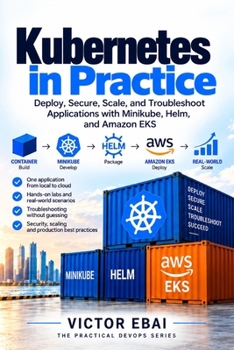
Kubernetes in Practice: Build, Operate, Troubleshoot, and Secure Kubernetes Applications with Confidence

Running a container is one thing. Operating applications reliably on Kubernetes requires a deeper understanding of how the platform behaves.
Kubernetes provides mechanisms to deploy, connect, recover, scale and secure applications. The harder skill is understanding how those mechanisms work together, recognising what normal behaviour looks like, gathering the right evidence when something fails, and making changes without creating new problems.
Kubernetes in Practice develops that engineering discipline through one continuous application that progresses from a local container into a production-style Kubernetes workload on Amazon EKS.
You build a practical mental model of declared state, reconciliation, ownership, resource relationships, request paths, security boundaries and observable evidence, then apply it through hands-on Kubernetes exercises. You learn to inspect what Kubernetes is actually doing, connect symptoms to the responsible boundary and verify that a change repaired the original problem.
The practical workflow is consistent throughout:
Build → Observe → Break → Diagnose → Fix → Verify
What you will learnThrough this progression, you will learn how to:
Understand how Pods, Deployments, ReplicaSets, Services and EndpointSlices work together to run and expose applications.
Deploy, scale and update workloads while reasoning about reconciliation, rollouts and recovery.
Trace application traffic through Services and Kubernetes DNS.
Manage application configuration and sensitive values using appropriate Kubernetes resources.
Design startup, readiness and liveness probes around actual application behaviour, then apply resource controls and horizontal autoscaling.
Harden workloads with security contexts, ServiceAccounts, RBAC, Pod Security and NetworkPolicy.
Troubleshoot systematically using resource status, events, logs, DNS, endpoints and the application request path.
Package and manage repeatable application releases with Helm.
Progress the same application from local Kubernetes to Amazon EKS.
Bring deployment, networking, security, scaling, troubleshooting and recovery together in a production-style final project.
A practical companion repositoryThe book is fully self-contained and is supported by a public companion repository containing the application source, progressive application versions, chapter-aligned Kubernetes manifests, a reusable Helm chart, Amazon EKS configuration, troubleshooting and cleanup guidance, and validation checks.
The repository provides ready-to-use material for inspecting, running and modifying the implementation, while the book develops the mental models, engineering decisions and guided investigations that explain how and why it works.
Companion repository: https: //github.com/vebai/kubernetes-in-practice
Who this book is forKubernetes in Practice is designed for software developers, DevOps engineers, platform engineers, cloud engineers, system administrators, support engineers and students with basic container experience who want to develop practical Kubernetes engineering capability.
No previous Kubernetes, Minikube, kubectl, Helm or Amazon EKS experience is required. Basic familiarity with Linux, containers, AWS fundamentals and YAML will help you follow the exercises.
By the end, the question changes from "Which Kubernetes command should I run?" to "What state should exist, what is Kubernetes actually doing, where is the problem, and how do I prove it is fixed?"
Declare the state. Observe the system. Diagnose the evidence. Fix the boundary. Verify the result.
Customer Reviews
ThriftBooks ® and the ThriftBooks ® logo are registered trademarks of Thrift Books Global, LLC
