


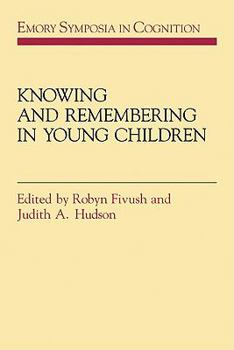
Knowing and Remembering in Young Children
No Customer Reviews

Select Format
Select Condition 
Book Overview
What kinds of memory demands are placed on young children and how are social interactions structured to allow children to develop various memory skills? Are there changes in children's representational abilities that lead to different memory abilities? How do individual differences affect children's memory performance? Are there age-related changes in children's autobiographical memories? These are among the questions addressed in this third volume in the Emory Cognition Project series, originally published in 1990. Although the contributors examine memory in different ways, they share the view that memory can no longer be considered a distinct and separate cognitive process isolated from other cognitive processes; rather, remembering is viewed as a cognitive activity embedded in larger social and cognitive tasks. This view is the culmination of several changes that took place in the field of cognitive development during the decade preceding publication.
Format:Paperback
Language:English
ISBN:0521125812
ISBN13:9780521125819
Release Date:January 2010
Publisher:Cambridge University Press
Length:368 Pages
Weight:1.19 lbs.
Dimensions:0.8" x 6.0" x 9.0"
Customer Reviews
0 rating
Copyright © 2026 Thriftbooks.com
Terms of Use | Privacy Policy | Do Not Sell/Share My Personal Information | Cookie Notice | Cookie Preferences | Accessibility Statement
ThriftBooks ® and the ThriftBooks ® logo are registered trademarks of Thrift Books Global, LLC
ThriftBooks ® and the ThriftBooks ® logo are registered trademarks of Thrift Books Global, LLC
