



Select Format
Select Condition 
Book Overview
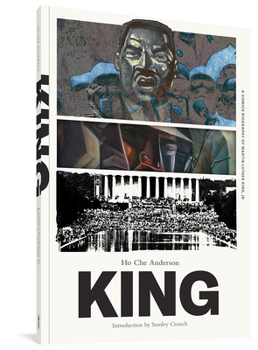
This groundbreaking body of comics journalism collects Anderson's entire biography of the renowned civil rights leader Rev. Martin Luther King, Jr. Over a decade in the making, the saga has been praised for its vivid recreation of one of the most tumultuous periods in U.S. history and for its accuracy in depicting the personal and public lives of King, from his birth to his assassination. King probes the life story of one of America's greatest public figures with an unflinchingly critical eye, casting King as an ambitious, dichotomous figure deserving of his place in history but not above moral sacrifice to get there. Anderson's expressionistic visual style is wrought with dramatic energy; panels evoke a painterly attention to detail but juxtapose with one another in such a way as to propel King's story with cinematic momentum. Anderson's successful use of the graphic novel to tell a major work of nonfiction has drawn favorable comparisons to Art Spiegelman's Maus: A Survivor's Tale , Joe Sacco's Palestine , and Osamu Tezuka's Adolph. King not only recreates the major events in King's public life, but chronicles the daily, rough-and-tumble, behind-the-scenes political maneuverings and strategic compromises that were required to mobilize millions of people toward a common goal. His internal debates with Ralph Abernathy and Jesse Jackson and his hardball negotiations with John F. Kennedy and Lyndon Johnson are dramatized. Anderson's achievement is not merely a political biography filled with names and dates, but a fully rounded portrait of a fallible human engaged in a superhuman effort his fears, his doubts, his relationship with his wife Coretta King, and his children are compassionately and truthfully rendered. Anderson's visual approach includes the use of photographs, realistic portraiture, and expressionistic imagery alternating between stark black and white chiaroscuro and painterly full color. The dialogue is unflinchingly naturalistic and accurately reflects the moral urgency and labyrinthine political and practical complexities that King was navigating, from his deeply felt, personal commitment to a public cause to the wider political eruptions the country was experiencing. This is a respectful, unsparing, truthful biography of a man and his times that captures the moral and political gravitas of the cause as well as its human dimension. A major work of comics, depicting a major work of history.
Format:Paperback
Language:English
ISBN:1560976225
ISBN13:9781560976226
Release Date:November 2021
Publisher:Fantagraphics Books
Length:228 Pages
Weight:0.60 lbs.
Dimensions:0.6" x 7.3" x 11.2"
Age Range:15 to 17 years
Grade Range:Grades 10 to 12
Customer Reviews
2 ratings
Not a plaster saint
Published by Thriftbooks.com User , 20 years ago
Anderson's style is so impressionistic that you would have to know the basic facts of King's life and career to get much out of it. That being said, this book is not another hagiography of King as a non-threatening figure whose message was that we should all be polite to each other. Anderson's King gets angry, gets hungry, gets horny, has periods of crippling despair; in other words, he was a human being. But he also stubbornly held onto what he felt was right, often in the face of powerful opposition. And make no mistake about it: charlatans and dolts like Bush II may invoke his name now, but Anderson makes clear that when he was alive, not everyone was standing around applauding. The King we see here is almost as polarizing a figure as, well, Jesus. After reading it, I understand anew why M.L. King was a great, if not a perfect, man.
Powerful and gripping
Published by Thriftbooks.com User , 20 years ago
The starkness of Ho Che Andersen's artwork is fitting in that it serves to heighten the mythological feel of King's life, which contrasts with the intimate portrait we get of the man and his daily struggles. The mixture of photography montage, black and white sketch work and the occassional, startling splash of color is mezmerizing. I don't know enough to comment on the historical accuracy of Andersen's work; the first volume of King was released in 1993 and it took the author a decade more to finish. This is a labor of love foremost, and the author's passion manages to leap off the page at you. That Andersen has avoided the pettiness of humanizing King is no small miracle - the biography genre routinely suffers from trivializing those it portrays in an effort to make them seem more familiar. My only complaint is the paraphrasing of much of King's "mountaintop speech" given the night before his death in Memphis. The speech is too long to be included in its entirety, but having listened to the audio clips of that speech too many times to recall I found Andersen's version lacking. I suppose this is only to be expected, but nonetheless I would have loved to have seen a few more pages devoted to what I consider a rhetorical masterpiece, and easily one of the greatest speeches ever given in America. If you've never heard it before, do your best to download it or otherwise listen to King at the height of his power; it is a speech much informed by the gift of sight and of prescience, and is all the more moving and remarkable for the last stanzas. If you are as fascinated with Martin Luther King as I am, I cannot recommend this work enough. Go out and buy it, and marvel, and remember one of the most pivotal figures of the twentieth century whose message should be heeded no matter the era.
Copyright © 2026 Thriftbooks.com Terms of Use
| Privacy Policy | Do Not
Sell/Share My Personal Information | Cookie Policy | Cookie Preferences | Accessibility Statement
ThriftBooks® and the ThriftBooks® logo are registered trademarks of Thrift Books Global, LLC
ThriftBooks® and the ThriftBooks® logo are registered trademarks of Thrift Books Global, LLC
