


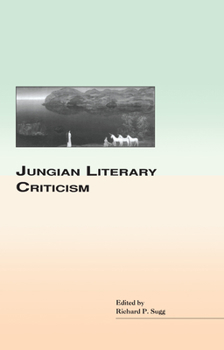
Jungian Literary Criticism


Select Format
Select Condition 
Book Overview
Jungian Literary Criticism presents a comprehensive, theoretical foundation for a tradition of study that has included some of the leading critics of our time. This collection provides critics, writers, psychologists, and others interested in the relationship between psychology and literature with classics of Jungian literary analysis and with the work of contemporary scholars building on that tradition.
Format:Paperback
Language:English
ISBN:0810110423
ISBN13:9780810110427
Release Date:January 1992
Publisher:Northwestern University Press
Length:439 Pages
Weight:1.35 lbs.
Dimensions:1.0" x 5.9" x 9.0"
Customer Reviews
2 ratings
Literary re-visioning
Published by Thriftbooks.com User , 16 years ago
Steven B. Herrmann, PhD, MFT Author of "William Everson: The Shaman's Call" It was Richard P. Sugg's hope, in editing Jungian Literary Criticism, that his book would "inspire the reader not only to new discoveries" but to a "literary re-visioning of Jungian psychology" itself (p. x). Over the years I have wondered what he meant. In the book Morris Philipson made an astute observation that Jung never provided an "adequate statement of what constitutes the creative autonomous complex," nor did he "specify the differentia by which the creative autonomous complex in the arts can be distinguished from the autonomous complex operating in the other spheres of creativity" (in Sugg, p. 217). In my view the autonomous complex has been wrongly divided in the field of Jungian literary criticism between the archetypes of the poet and the healer, and thus two engrams or imprints that ought to be related and functioning together instead form the basis for a current tension. What I feel is needed in the field of Jungian literary criticism is a conscious descent to the shamanic core that underlies both the psychological and the aesthetic views. This is no easy task. Yet, as I see it, it is where Jung and Freud started. Both men took their inspiration from poets. It is clear from reading Sonu Shamdasani's Introduction to Jung's Red Book that Jung modeled his method of writing on Nietzsche's Zarathustra. It is also clear that Goethe was Jung's favorite poet. Reading Sugg's book fourteen years ago, I wondered what American poetry might have to contribute to the field of Jungian psychology. There are some wonderful papers selected by Sugg that can answer this question. Jungian Literary Criticism is a wonderful array of papers written by both analysts and literary scholars and it illuminates the way Jung has opened up a whole new way of analyzing literary works of art. I highly recommend this book to any analyst, layperson, or writer who is interested in the way that Jungian thought is being used to analyze literary texts and how scholars are contributing to our understanding of the human psyche.
great collection of essays on archetypal literature/criticis
Published by Thriftbooks.com User , 30 years ago
Containing thirty-two essays by the greatest archetypal critics, this is an excellent introduction to the possibilities of seeing literature in a new way: as directly related to the individual psyche. This view of literature and its human function reminds us of literature's roots in myth and, before that, religion itself. Also, it relates literature to the most important scientific efforts of the past two decades, the exponentially increasing understanding of the sub-conscious strata--including all genetic coding--of our human nature
Copyright © 2026 Thriftbooks.com
Terms of Use | Privacy Policy | Do Not Sell/Share My Personal Information | Cookie Notice | Cookie Preferences | Accessibility Statement
ThriftBooks ® and the ThriftBooks ® logo are registered trademarks of Thrift Books Global, LLC
ThriftBooks ® and the ThriftBooks ® logo are registered trademarks of Thrift Books Global, LLC
