


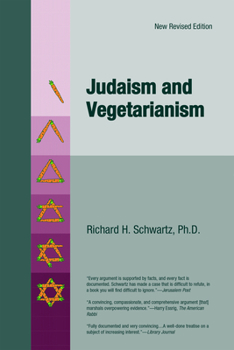
Judaism and Vegetarianism: New Revised Edition

Select Format
Select Condition 
Book Overview
From God's first injunction, "Behold, I have given you every herb yielding seed, which is upon the face of all the earth, and every tree, in which is the fruit of a tree yielding seed, to you it shall... This description may be from another edition of this product.
Format:Paperback
Language:English
ISBN:1930051247
ISBN13:9781930051249
Release Date:February 2001
Publisher:Lantern Publishing & Media
Length:256 Pages
Weight:0.85 lbs.
Dimensions:0.6" x 6.1" x 9.0"
Customer Reviews
5 ratings
A convincing look at the Bible's look on vegetarianism
Published by Thriftbooks.com User , 24 years ago
I wrote a review on this book for the newsletter for the winter 2001 newsletter for the animal rights group, Last Chance for Animals. I am including my review here:Richard H. Schwartz's Judaism and Vegetarianism is a useful reference for refuting claims that humans and animals do not deserve equal consideration. It effectively explains and elaborates upon the Bible's stance on vegetarianism and explores other moral and societal issues with which non-religious people can identify; Schwartz even includes a section on how vegetarianism can promote awareness and ultimately resolve these issues. The book also contains answers to common questions, nutritional suggestions, discussions of Jewish vegetarian groups and their activities, biographies of famous Jewish vegetarians, an annotated bibliography, ideas for promoting vegetarianism, and a detailed index. In sum, Schwartz has produced a well-documented, well-reasoned, and very convincing work which ends with a query to Jews who plan to continue eating meat: "In view of strong Jewish mandates to be compassionate to animals, preserve our health, help feed the hungry, preserve and protect the environment, conserve resources, and seek and pursue peace, and the very negative effects animal-centered diets have in each of these areas, will you now become a vegetarian, or at least sharply reduce your consumption of animal products?".
Compassion and responsibility
Published by Thriftbooks.com User , 24 years ago
I have read this book thoroughly, and I think it is the most informative, most complete and most readable book about vegetarianism I have ever read. The book is very well structured, the information given is presented clearly and is up to date. Since I am a vegan, I have paid extra attention to what is being said about veganism, and I found the author is objective, accurate and gives sound advice. The B12 issue is dealt with in a responsible manner and I think it is very wise to present the transition to vegetarianism and from there to veganism as a process of growth, where every step counts. The author gives many practical suggestions on how to make changes in your lifestyle without losing touch with family or friends and manages to be firm and friendly at the same time. These things alone make the book a purchase well worth the investment. For me, however, the particular merit of the book lies in the spiritual values that have inspired it. Reading the book from a non-Jewish perspective, what struck me most was that the author has chosen focal points which are relevant to people from all kinds of different backgrounds, Jews, Muslims, Christians, Hindus, Buddhists and people who are not religious in the 'traditional' sense. In short, all those who are concerned about the way we relate to our environment from a spiritual point of view. The first focal point is that ethical considerations are more important than habit, convenience, or tradition, and the second is that there will be a price to pay if we chose to ignore the ethical imperative to change our ways. There are many books explaining why it is better for your body to become a vegetarian; there are not many books explaining why it is better for your soul. Richard Schwartz makes the reader see how the themes of inclusion and compassion towards animals are woven all through the Torah. Having read theology at a fairly orthodox Christian college, I have often heard the argument that `since Man was created in the image of God, he was given dominion over all creation' as an excuse for the maltreatment of animals and their reduction to `meat-producing units'. Guided by Richard Schwartz, we are shown that according to the Torah both man and beast are creatures of God, and that our being created in the image of God is not a given, but rather a potential; something to be brought into manifestation by following the pattern God has laid out for us, and that one of the qualities we must manifest is compassion. Instead of feeling very proud of ourselves and thinking that we are like God already, we should realise that we are asked to imitate God in love and concern for all living beings. Instead of 'dominion' we should read 'compassionate stewardship', and that is something else entirely. From the idea of our potential for goodness and compassion, the theme of responsibility is developed. The author shows us how we are responsible, in the sense of being accountable for the wrongs we do not try to stop. By
What you always wanted to know about vegetarianism
Published by Thriftbooks.com User , 24 years ago
ORANGE COUNTY PEOPLE FOR ANIMALS (OCPA) creating a compassionate, healthy and peaceful planet June 18, 2001Review of JUDAISM AND VEGETARIANISM by Richard Schwartz, Ph.D.I thoroughly enjoyed this book. I felt it was sequentially well organized, clearly written, educational and inviting. Some publications encouraging veganism or vegetarianism tend to lean toward superiority or scare tactics. However, the style of this author and text leaned more toward informative humility.I enjoyed the ways in which Dr. Schwartz established justications and relationships between quotations and teachings from the Bible and/or the Torah in favor of a vegan/vegetarian life as they relate to: agribusiness, environmental destruction, human starvation, debilitating hunger-related diseases, heart disease and obesity, civil unrest, political/petrochemical devastation and disregard for life and, of course, the barbaric treatment of farmed animals.All questions and answers sections were absolutely wonderful! Those sections alone could be invaluable pamphlets that could address those "Things you always wanted to know about vegetarianism/veganism but were afraid to ask." All answers were succinct and yet detailed, passionate and yet humbling.I would recommend this book to anyone interested in any of the myriad reasons to be vegan and/or vegetarian. And for people whose lives are intertwined with Judaism, it offers explicit and thought-provoking rationale from that point of view for a cruelty-free lifestyle.For ALL living beings, Veda Stram Outreach for OCPAThe Mission of Orange County People for Animals is to have our guiding principles present in the everyday fabric of society: * Every being has the right to live free from exploitation. * By educating people, we will create a compassionate, healthy and peaceful planet. * There are consequences to every individual's actions. * All life is interconnected.
An Outstanding Resource!
Published by Thriftbooks.com User , 24 years ago
I read this book about three weeks ago, and reviewed it for[another source]. Rather than reinvent the wheel, here is the review I posted there (reposted with permission from VegSource):"Judaism and vegetarianism? Can the two be related? After all, what is a simcha (Jewish celebration) or holiday dinner without gefilte fish, chopped liver, cholent, roast beef, chicken and chicken soup? And what about passages in the Torah referring to Temple sacrifices of animals and the consumption of meat?"This question, quoted here from the preface to the first edition of Richard Schwartz's seminal work Judaism and Vegetarianism, has often plagued Jews considering a switch to a vegetarian lifestyle, as well as vegetarians considering Judaism. CAN one be Jewish and vegetarian? Don't the Scriptures sanction...indeed, appear to command...the consumption of meat? What is God's will regarding His people and their relationship with the animals, the Earth, and with other peoples? How does vegetarianism fit in (or does it?)?In this book, Professor Schwartz demonstrates that, not only is vegetarianism wholly consistent with Judaism, it may even be considered an imperative in this day of factory farming, environmental depletion, degenerating human health and worldwide hunger. Beginning, as is fitting, with the Scriptures (particularly the Torah), Schwartz takes his readers on a tour of the Bible from a vegetarian point of view. He then goes on to address specific issues, such as "Tsa'ar Ba'alei Chayim - Judaism and Compassion for Animals"; "Judaism, Vegetarianism, and Health"; "Judaism, Vegetarianism, and Feeding the Hungry"; "Judaism, Vegetarianism, and Ecology"; and "Judaism, Vegetarianism and Peace"; supporting each not only with quotes from the Scriptures, but also with insight from Jewish sages and scholars from virtually every age and tradition, as well as with substantial and timely factual material gleaned from leading authorities on animal welfare, human health, the environment and the world hunger situation. He then proceeds to address even more specific questions regarding Judaism and vegetarianism (such as "Don't Jews have to eat meat to honor the Sabbath and to rejoice on Jewish holidays?" and "If God wanted us to have vegetarian diets and not harm animals, why were the Temple sacrificial services established?") and vegetarianism in general (such as "Can't one work to improve conditions for animals without being a vegetarian?" and "If vegetarian diets are best for health, why don't most doctors recommend them?"). Finally he offers solid advice on how to make the switch to vegetarianism, including information on holiday observances and information on Jewish vegetarian groups, activities and resources, as well as an interesting and informative biographical section on famous Jewish vegetarians. He closes with this question, respectfully addressed to Jews who plan to continue to eat meat: "In view of strong Jewish mandates to be compassionate to animals, preser
This new edition is the best yet!
Published by Thriftbooks.com User , 25 years ago
I have just finished reading the manuscript for this newly-revised third edition (due out November 21) and it is absolutely superb! Dr. Schwartz literally "wrote the book" on this topic many years ago, and, with each new edition, it just gets better and better. His book is of interest to both Jews and non-Jews who want to understand what Judaism has to say about vegetarianism and the treatment of animals, written from the perspective of Jewish law and ethics. What makes this work different from other vegetarian books is that Dr. Schwartz is himself a religous Jew (Modern Orthodox), who takes both Jewish law and his vegetarianism very seriously. Recognizing that Jews have, by and large, tended to be meat-eaters in past centuries, Dr. Schwartz does not seek to attack Judaism itself for this. Rather, he carefully examines what Jewish law has to say about the treatment of animals in the light of modern factory farms, along with the responsibity to feed the hungry and care for the environment, and comes to the conclusion that vegetarianism is the logical choice for a religious Jew today, if he or she wants to avoid causing undue suffering to both animals and fellow human beings. This book is meticulously researched, providing hundreds footnoted sources, including the famous quote by Rabbi Abraham Issac Kook, concerning his beliefs about Jews being vegetarian in the Messianic Age. (Previous editions of "Judaism and Vegetarianism" gave this quote but no original source reference, causing some anti-vegetarians to claim that it did not really exist. Thank you, Dr. Schwartz, for finally setting the record straight!) Much of the old material has been carefully updated, and new material is added, with an expanded section explaining the important kabbalistic and Hasidic doctrine of "raising up the holy sparks" in food, and how this might be reconciled with vegetarianism. All in all, this is a book that every vegetarian activist should have!
Copyright © 2026 Thriftbooks.com Terms of Use
| Privacy Policy | Do Not
Sell/Share My Personal Information | Cookie Policy | Cookie Preferences | Accessibility Statement
ThriftBooks® and the ThriftBooks® logo are registered trademarks of Thrift Books Global, LLC
ThriftBooks® and the ThriftBooks® logo are registered trademarks of Thrift Books Global, LLC
