


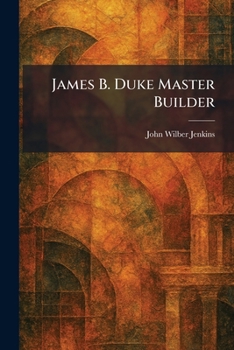
James B. Duke Master Builder

"James B. Duke Master Builder" is an insightful biographical study of one of the most prominent industrial figures in American history. Written by John Wilber Jenkins, this work provides a detailed exploration of the life and career of James Buchanan Duke, whose visionary leadership transformed the tobacco industry and revolutionized the production of electric power in the South. The narrative follows Duke's rise from his early years in rural North Carolina to his position as the head of the massive American Tobacco Company, illustrating the persistence and strategic genius that defined his business ventures.
The text focuses on Duke's dual legacy as both a captain of industry and a dedicated philanthropist. Jenkins examines the development of Duke Power and its role in the industrialization of the Piedmont region, alongside the monumental establishment of The Duke Endowment. A significant portion of the work highlights the founding and endowment of Duke University, showcasing his commitment to education and social progress. This biography serves as a vital historical record of the Gilded Age and the early 20th century, offering a window into the economic and cultural shifts that shaped modern America. "James B. Duke Master Builder" is an essential read for those interested in industrial history, Southern heritage, and the life of a man who built an enduring institutional legacy.
This work has been selected by scholars as being culturally important, and is part of the knowledge base of civilization as we know it. This work was reproduced from the original artifact, and remains as true to the original work as possible. Therefore, you may see the original copyright references, library stamps (as most of these works have been housed in our most important libraries around the world), and other notations in the work.
This work is in the public domain in the United States of America, and possibly other nations. Within the United States, you may freely copy and distribute this work, as no entity (individual or corporate) has a copyright on the body of the work.
As a reproduction of a historical artifact, this work may contain missing or blurred pages, poor pictures, errant marks, etc. Scholars believe, and we concur, that this work is important enough to be preserved, reproduced, and made generally available to the public. We appreciate your support of the preservation process, and thank you for being an important part of keeping this knowledge alive and relevant.
Customer Reviews
ThriftBooks ® and the ThriftBooks ® logo are registered trademarks of Thrift Books Global, LLC
