


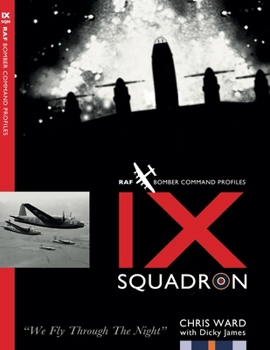
IX Squadron Profile: RAF Bomber Command Squadron Profiles
No Customer Reviews

Between the wars, IX Squadron had built a reputation as a specialist bombing unit and had the honour of conducting the first bombing operation of the Second World War, an attack on German surface vessels in the shipping lanes off Brunsb ttel on the 4th of September 1939, the day after war had been declared. In the following thirty-five months, whilst stationed at RAF Honington in Suffolk as part of 3 Group, the squadron took part in 2,333 combat operations, losing in the process sixty-six Wellington bombers and 342 members of aircrew. In August 1942 the Squadron transferred to 5 Group and took up residence initially at Waddington near Lincoln, where it re-equipped with the legendary Avro Lancaster, before moving in April 1943 eleven miles east to a new station at Bardney. During its thirty-three month-long 5 Group career, IX Squadron was involved in some of the most spectacular bombing operations of the war, including the epic daylight raid on the Schneider armaments works at Le Creusot in October 1942 and the attack on the W rzburg radar factory in the old Zeppelin sheds at Friedrichshafen deep in southern Germany in June 1943. It participated in all of Bomber Command's campaigns, against the Ruhr in the spring and summer of 1943, the destruction of Hamburg and the Peenem nde secret weapons establishment in July and August and was a participant in all nineteen operations against Berlin between August 1943 and March 1944. The spring of 1944 brought the pre-invasion destruction of the French railway system, while the summer was dominated by concurrent campaigns against V-Weapons, oil refineries and railways, with tactical support for the ground forces an additional responsibility. In August 1944, IX Squadron became one of only two "specialist" bomber units in concert with 617 Squadron when tasked with employing the 12,000lb Barnes Wallis-designed Tallboy earthquake bomb against precision targets. In this role, the squadron took part in the three operations leading to the eventual sinking of the mighty battleship, Tirpitz, in September, October and November 1944. The Squadron's final operation targeted the S S barracks and Hitler's Eaglesnest retreat at Berchtesgaden in the Bavarian mountains in daylight on the 25th of April 1945. IX Squadron carried out 3,495 operations in Lancasters, losing 111 of them and a further twenty-two in crashes in England. During the Second World War, IX Squadron personnel were awarded one VC, 4 DSOs, one CGM, 129 DFCs and 88 DFMs. This is the operational story of this magnificent squadron, the information drawn mostly from the squadron's Operational Record Books (ORBs) and personal accounts.
Format:Paperback
Language:English
ISBN:1915335183
ISBN13:9781915335180
Release Date:July 2023
Publisher:Aviation Books Ltd
Length:508 Pages
Weight:2.57 lbs.
Dimensions:1.0" x 8.5" x 11.0"
Related Subjects
HistoryCustomer Reviews
0 rating
Copyright © 2026 Thriftbooks.com
Terms of Use | Privacy Policy | Do Not Sell/Share My Personal Information | Cookie Policy | Cookie Preferences | Accessibility Statement
ThriftBooks ® and the ThriftBooks ® logo are registered trademarks of Thrift Books Global, LLC
ThriftBooks ® and the ThriftBooks ® logo are registered trademarks of Thrift Books Global, LLC
