


Is cruelty cool?

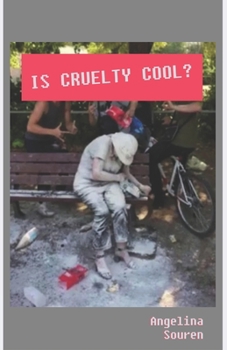
The woman in the photo on the cover, that's Janice Morris. It is also in a sense me, the author of this book, as I too was attacked while sitting on a bench in England. Two stones hit my head as I was reading and annotating a report for the Dutch version of Forensics for Dummies. Water and sand were also thrown at me, so I was lucky I was not working on a laptop at the time. My bench stood in Southampton, Janice's bench in Bury St Edmunds.
Fast forward a few years. I am walking along London Road/Kingston Road in Portsmouth on a Sunday afternoon and two young men say hello to me from a window right above me, near Kingston Crescent. When I return the greeting "good afternoon", they empty a bucket with liquid over me. It goes on and on and on. I got angrier and angrier. So I wrote this book. For myself and for Ms Morris and for all the other otherised human beings in England. That's the3million and the Windrush generation and all the other non-UK citizens, the so-called disabled, the women, the feeble-minded and confused, all the uppity females who don't know their place, the poor, the elderly, many of the educated and most of the barely educated and, of course, everyone whose skin is not lily-white. This book is also for individuals who believe that cruelty gives them edge. It is for all the perpetually hurting people whose early childhoods have driven them into the pursuit of cruelty as their brains were never taught any other sources of joy.In addition, it is of course for black people and native-American people in the US as well as for migrants all over the world. It is for people who are workplace bullies or who used to be workplace bullies and for people who are the target of workplace bullying and community bullying or who have a friend or colleague who is being bullied in the community or at work.
It could also be of use for some employers. In a recent landmark ruling, Landrover Jaguar saw itself burdened with the complication of constructive dismissal after it failed to act when one of its engineers was subjected to workplace bullying. The book discusses two cases of staff being set on fire at work as if this were the most normal thing in the world to do.
Does cruelty bring joy? Does it begin with hate? I, the Dutchwoman who wrote this book, have been living in England for over fifteen years. I wondered where England's glorification of cruelty came from and dove into the topic.
Do people like Boris Johnson and Priti Patel - and, yes, certainly also Theresa May and Iain Duncan Smith and all the others - know how much hate and aggression they have sown in the country? Do they realise that many of their statements narrow the gap between verbal aggression and physical aggression towards "others", thus lowering the threshold to violence?
Does Keir Starmer genuinely believe that there is no police brutality in England and that BLM is no more than a daft American phenomenon that has no place in England? Ask yourself, if an independent professional, an intelligent, highly capable and educated white Dutchwoman from Amsterdam without disabilities gets abused in England, then what does that mean for people in England who are not white or who do have a so-called impairment? What does this mean for autistic children? What does it mean for the millions and millions of Brits who have been stuck in poverty all their lives and whose agency gets taken away all the time?We would all fare better if the world became a more compassionate and more inclusive place. So easy to say, so hard to put into practice.
WARNING: This book surely contains trauma triggers for some people and I certainly do not mince my words in this book.
This book has a classy white interior. Also available with subdued, cream-coloured pages or as e-book.
Customer Reviews
ThriftBooks® and the ThriftBooks® logo are registered trademarks of Thrift Books Global, LLC
