
Skip to content
Scan a barcode
Scan
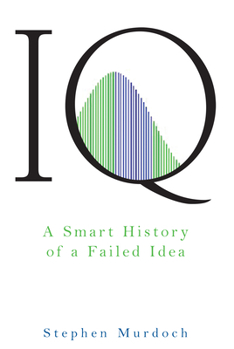
Hardcover IQ: A Smart History of a Failed Idea Book

ISBN: 0471699772

ISBN13: 9780471699774

IQ: A Smart History of a Failed Idea

Select Format

Select Condition ThriftBooks Help Icon

Recommended

Format: Hardcover

Condition: Good

$5.39
Save $19.56!
List Price $24.95
Almost Gone, Only 1 Left!

Book Overview

Advance praise for

IQ A Smart History of a Failed Idea

""An up-to-date, reader-friendly account of the continuing saga of the mismeasure of women and men.""
--Howard Gardner, author of Frames of Mind and Multiple Intelligences: New Horizons

""The good news is that you won't be tested after you've read Stephen Murdoch's important new book. The better news is that IQ: A Smart History of a Failed Idea is compelling from its first pages, and by its conclusion, Murdoch has deftly demonstrated that in our zeal to quantify intelligence, we have needlessly scarred--if not destroyed--the lives of millions of people who did not need an IQ score to prove their worth in the world. IQ is first-rate narrative journalism, a book that I hope leads to necessary change.""
--Russell Martin, author of Beethoven's Hair, Picasso's War, and Out of Silence

""With fast-paced storytelling, freelance journalist Murdoch traces now ubiquitous but still controversial attempts to measure intelligence to its origins in the late nineteenth and early twentieth centuries. . . . Murdoch concludes that IQ testing provides neither a reliable nor a helpful tool in understanding people's behavior, nor can it predict their future success or failure. . . . A thoughtful overview and a welcome reminder of the dangers of relying on such standardized tests.""
--Publishers Weekly

""Stephen Murdoch delivers a lucid and engaging chronicle of the ubiquitous and sometimes insidious use of IQ tests. This is a fresh look at a century-old and still controversial idea--that our human potential can be distilled down to a single test score. Murdoch's compelling account demands a reexamination of our mania for mental measurement.""
--Paul A. Lombardo, author of Three Generations, No Imbeciles: Eugenics, the Supreme Court & Buck v. Bell

Customer Reviews

5 ratings

This comes from a Mensan

OMG, I'm so glad to see that somebody has a scientific approach to IQ research. I believe that the most important part of testing IQ is to find very bright kids coming from highly disadvantaged backgrounds and help them succeed and give back to society. For that reason, we need a way to test mental quickness and complexity, not knowledge or culturally based thinking. If the hardware allows it, you can add any software. The more I was digging into books like The Bell Curve, the more upset I became about the way the authors conducted their research. The Bell Curve praises Jews and incidentally, one of the authors is Jewish. They also happened to use the Weis IQ test that has a multitude of grading issues in addition to being based largely on knowledge (Who is Catherine the Great?) and it relies on run-of-the-mill, taught-in-US-schools kind of thinking. Is it fair to ask the starving Africans what the speed of light is and grade them as if they were stupid for not knowing it? Thank you for writing this book!

A candent issue that still remains in the eye of the hurricane!

Psychometry is an attempt to measure the development of intelligence. Conceived by Binet (1857-1911) appropriated the methods of Broca's "craniometry" and Lombroso' s anatomical stigmatization used them to fashion a smart tool in the form of mental tests. Developed in France, originally these investigations were devoted to find and identify the main obstacles to learning in low achievers at school. A scale of tests were allocated in order to the tasks that each age group was capable of. So, " mental age" was born as concept. But we had to wait until 1912 when the psychologist Stern proposed, instead, that the mental age, divided by the chronological age was the seminal seed of the IQ (Intelligence Quotient). It's good to notice Darwin's evolution theory reached a boiling point state specially between 1910 and 1930 (the famous legal discussion of James Brady,which has been described with extreme detail in the film "Inherit the wind"), that was a key factor to redefine the IQ in terms of biological heredity. This issue emerged from the labs to the highest political spheres (debated in Congress in 1924) was partially to well-known Immigration Restriction Act for not to mention the uses and abuses of this discipline to define the perfect measures based on racist premises in the Nazi Regime. But there's still more. In 1972 the State of Virginia a law repealed legalized the sterilization of adults whose mental age was scored of 7, 8 or 9. But the final dictate of resolution in 1927 of a Supreme Court literally pointed the ethical question in the center of the flame. Is it better to prevent the patently incapable rather to regard the expected hunger of a degenerate offspring dying of hunger because they were idiots?.

Demystifies a topic that every American should understand

Given the centrality of intelligence testing to contemporary American culture, I am always amazed by how little most people know about it. Even among my graduate students in psychology, few know the word "eugenics," the ideology at the core of the creation and spread of the tests that are now so influential in education, industry, the military, and even the courts. Stephen Murdoch does a great job demystifying the topic. Chapters address the World War I "Alpha" and "Beta" testing, the Nazis' use of IQ testing, the SAT (a very informative chapter), the black-white test score gap, and the increasingly important role of intelligence testing in capital punishment decision-making in the wake of the recent Atkins v. Virginia decision (which banned execution of mentally retarded defendants). As Murdoch explains, "Most psychologists believe they can test intelligence and the measured entity is extremely important." He easily punctures that overinflated belief. For those who are unfamiliar with this topic, the book is a great place to start. As a journalist, Murdoch communicates the history and ideology underpinning intelligence testing in plain English. His writing flows smoothly and easily, making what could be a strenuous topic a pleasure to read. If you already know the basics, you'll still learn something. The sections on early history are more comprehensive than his discussions of the current controversies. For example, as a forensic psychologist I would have liked to see more depth and practicality to the discussion of alternatives to IQ testing. I would also have liked better annotation of sources. But these are fairly minor quibbles with what is overall a solid piece of reporting.

written for every-day folks

It is about time someone demystified standardized testing and this book does it with accuracy, wit and unveils it in a story-telling fashion. As crazy as this sounds, once you start it, you can't put the book down. and may even ignore that great fiction thriller you've beeen reading.

Captivating Premise -- Really struck a chord

The issue Murdoch raises really strikes a chord. My wife is a teacher, and she constantly laments the intrusion of more and more standardized testing into the educational process. All of these tests, and the entire testing craze, derive from the same mentality, mind-set and techniques that originated with the first IQ tests. Murdoch takes you through the history and evolution of the IQ Test, which is fascinating in and of itself, but the real payoff of the book is the realization you get as you read it that these tests are really very arbitrary in their design, and can be very misleading -- especially during a person's formative years. The subject is presented logically and clearly, and examples from real life make it far more readable than you might expect for a subject like this. Murdoch bares his opinion of the subjet early on, but that's fine with me -- at least he puts his cards on the table. If this book had been written by an academic (Murdoch is a journalist) it would probably have the same pretense of objectivity that IQ tests have. Overall I highly recommend this book, especially to psychologists, admissions officers, and parents of young children.
Copyright © 2026 Thriftbooks.com Terms of Use | Privacy Policy | Do Not Sell/Share My Personal Information | Cookie Policy | Cookie Preferences | Accessibility Statement
ThriftBooks® and the ThriftBooks® logo are registered trademarks of Thrift Books Global, LLC

GoDaddy Verified and Secured