


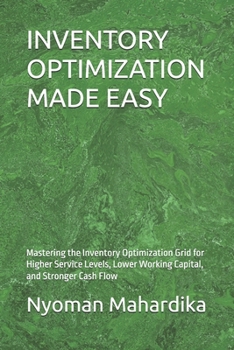
Inventory Optimization Made Easy: Mastering the Inventory Optimization Grid for Higher Service Levels, Lower Working Capital, and Stronger Cash Flow
No Customer Reviews

Many books about inventory management begin with complicated formulas.
This one begins with a business problem.
Imagine arriving at work on Monday morning.
Your Finance Director tells you inventory has reached a record level, consuming valuable working capital.
Ten minutes later, your Sales Director complains that several major customers experienced stock-outs over the weekend.
Operations insists production is running efficiently.
Procurement explains suppliers delivered exactly as scheduled.
Warehouse managers say every shelf is full.
Everyone appears to be doing their job.
Yet customers are unhappy, cash flow is deteriorating, and inventory continues to increase.
How is that possible?
The answer is simple.
Every department has optimized its own objectives.
Very few organizations optimize the entire supply chain.
Inventory exists precisely because supply and demand rarely occur at exactly the same time.
Customers buy unpredictably.
Suppliers experience delays.
Factories encounter downtime.
Promotions create demand spikes.
Raw material prices fluctuate.
Transportation is disrupted.
Inventory acts as the buffer that absorbs these uncertainties.
The challenge is deciding how much buffer is enough.
Too little inventory creates risk.
Too much inventory creates waste.
Finding the balance between these two extremes is one of the most important responsibilities in supply chain management.
This book provides a practical roadmap for achieving that balance.
Rather than overwhelming readers with academic theory, it focuses on practical decision-making.
Each chapter builds progressively from fundamental concepts toward implementation.
Along the way, you will learn how to: Understand why inventory exists.Measure inventory performance correctly.Calculate practical safety stock.Improve demand planning.Integrate inventory decisions into the S&OP process.Prioritize products using the 3D Inventory Optimization Grid.Reduce working capital without compromising customer service.Create a culture of continuous inventory improvement.The concepts presented here are intentionally practical.
Most organizations already possess the necessary information.
Sales history.
Lead times.
Inventory records.
Profit margins.
Working capital.
The challenge is not collecting more data.
The challenge is making better decisions using the data already available.
Throughout this book you will find examples drawn from real business situations.
Although the industries differ, the lessons remain universal.
Inventory optimization is fundamentally about making better business decisions.
The tools are simple.
The discipline is continuous.
The rewards are substantial.
This one begins with a business problem.
Imagine arriving at work on Monday morning.
Your Finance Director tells you inventory has reached a record level, consuming valuable working capital.
Ten minutes later, your Sales Director complains that several major customers experienced stock-outs over the weekend.
Operations insists production is running efficiently.
Procurement explains suppliers delivered exactly as scheduled.
Warehouse managers say every shelf is full.
Everyone appears to be doing their job.
Yet customers are unhappy, cash flow is deteriorating, and inventory continues to increase.
How is that possible?
The answer is simple.
Every department has optimized its own objectives.
Very few organizations optimize the entire supply chain.
Inventory exists precisely because supply and demand rarely occur at exactly the same time.
Customers buy unpredictably.
Suppliers experience delays.
Factories encounter downtime.
Promotions create demand spikes.
Raw material prices fluctuate.
Transportation is disrupted.
Inventory acts as the buffer that absorbs these uncertainties.
The challenge is deciding how much buffer is enough.
Too little inventory creates risk.
Too much inventory creates waste.
Finding the balance between these two extremes is one of the most important responsibilities in supply chain management.
This book provides a practical roadmap for achieving that balance.
Rather than overwhelming readers with academic theory, it focuses on practical decision-making.
Each chapter builds progressively from fundamental concepts toward implementation.
Along the way, you will learn how to: Understand why inventory exists.Measure inventory performance correctly.Calculate practical safety stock.Improve demand planning.Integrate inventory decisions into the S&OP process.Prioritize products using the 3D Inventory Optimization Grid.Reduce working capital without compromising customer service.Create a culture of continuous inventory improvement.The concepts presented here are intentionally practical.
Most organizations already possess the necessary information.
Sales history.
Lead times.
Inventory records.
Profit margins.
Working capital.
The challenge is not collecting more data.
The challenge is making better decisions using the data already available.
Throughout this book you will find examples drawn from real business situations.
Although the industries differ, the lessons remain universal.
Inventory optimization is fundamentally about making better business decisions.
The tools are simple.
The discipline is continuous.
The rewards are substantial.
Format:Paperback
Language:English
ISBN:B0H8CKLHS8
ISBN13:9798186615576
Release Date:July 2026
Publisher:Independently Published
Length:110 Pages
Weight:0.35 lbs.
Dimensions:0.2" x 6.0" x 9.0"
Customer Reviews
0 rating
Copyright © 2026 Thriftbooks.com
Terms of Use | Privacy Policy | Do Not Sell/Share My Personal Information | Cookie Policy | Cookie Preferences | Accessibility Statement
ThriftBooks ® and the ThriftBooks ® logo are registered trademarks of Thrift Books Global, LLC
ThriftBooks ® and the ThriftBooks ® logo are registered trademarks of Thrift Books Global, LLC
