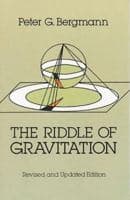
Comprehensive coverage of special theory (frames of reference, Lorentz transformation, more), general theory (principle of equivalence, more) and unified theory (Weyl's gauge-invariant geometry, more.) Foreword by Albert Einstein.
on telling you that the author was on of the two to three collaborators of Einstein (The others being Valentine Bargmann and Leopold Infeld) on Unified field theories. It is a beautifully written account of the gravitational theory. The monster mind himself has written the foreword.
0
★★★★★
Excellent first exposure
By Thriftbooks.com User, March 5, 2001
Don't know of a superior first exposure to relativity. It starts with elementary situations and examines the conflicts with pre-relativistic kinematical viewpoints. This motivates the requirements for special relativities' postulates and their immediate consequences.From here, the more complex issues of special relativity are dealt with in an orderly fashion; e.g. rigid body dynamics, relativistic hydrodynamics and electromagnetic theory from a relatavistic point of view.General tensor analysis is covered in a separate chapter for pursuing the general relativity chapters of the book. Incidentally, this chapter is among the most clear expositions on tensors out there.Finally, general relativity is covered in the same stepwise fashion as was done in the special relativity chapters. The natural introduction of more complex ideas which start from basics is perhaps, the single reason why this book is a hard to beat introduction to relativity.After a thorough digestion of Bergmann, one is ready to spring up to the next level, the masterful Weinberg.
0
★★★★★
Making the complex understandable
By Thriftbooks.com User, December 6, 2000
Peter was able to give examples which made the complex easier to understand. The edges of the first sections in a copy in the Caltech library were black from use. I was privileged to be a guinea pig for the first edition.
1
★★★★★
A masterpiece in physics.
By Thriftbooks.com User, December 7, 1999
This book describes the foundations of relativity in a clear and concise way. The development of tensor analysis is especially clear. It is great for anyone who has studied calculus, differential equations, and classical physics. I highly recommend it.
0
★★★★★
Pretty darn good.
By Thriftbooks.com User, October 19, 1999
Hey, it's endorsed by big Al, himself. The math intro pretty much does it all, but it would be good if you have a firm grasp of vector calculus, and linear algebra. And intro undergraduate physics wouldn't hurt, either.