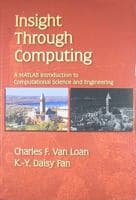
Unique in content and approach, this book covers all the topics that are usually covered in an introduction to scientific computing--but folds in graphics and matrix-vector manipulation in a way that gets readers to appreciate the "connection" between continuous mathematics and computing. "MATLAB 5" is used "throughout" to encourage experimentation, and each chapter focuses on a different important theorem--allowing readers to appreciate the rigorous side of scientific computing. In addition to standard topical coverage, each chapter includes 1) a sketch of a "hard" problem that involves ill-conditioning, high dimension, etc.; 2)at least one theorem with both a rigorous proof and a "proof by MATLAB" experiment to bolster intuition; 3)at least one recursive algorithm; and 4)at least one connection to a real-world application. The book revolves around examples that are packaged in 200+ M-files, which, collectively, communicate all the key mathematical ideas and an appreciation for the subtleties of numerical computing. Power Tools of the Trade. Polynomial Interpolation. Piecewise Polynomial Interpolation. Numerical Integration. Matrix Computations. Linear Systems. The QR and Cholesky Factorizations. Nonlinear Equations and Optimization. The Initial Value Problem. For engineers and mathematicians. This description may be from another edition of this product.
This is a well written introduction to scientific computing. It is not written for the professional, the graduate student, or the advanced undergraduate. Rather, this book is aimed at the lower division undergraduate who possesses a basic knowledge of calculus, linear algebra, programming. In that context it is clear, interesting, and well presented.
1
★★★★☆
A comprehensive guide towards computational linear algebra
By Thriftbooks.com User, March 11, 2000
Professor Van Loan provides a comprehensive text in the computational aspects of linear algebra, and his choice to include an explanation of computational methods with vectors and matrices within the context of Matlab offers students a clearer insight into how computetrs deal with linear algebra. A careful reader will be enlightened by algorithms which greatly increase computational efficiency. However, the book has its share of typos which can confuse people trying to understand the various Matlab scripts. I found that the chapter dealing with splines was extremely hard to understand without supplemental information. I would have like to seen more consistency as far as complexity analyses; while some algorithms provided clear runtime analyses, others did not. Also, some scripts could have been accompanied by a clearer explanation; it is often not intuitive how the writer got from the algorithm to actual code. All in all, by discussing computational methods in matrix-vector and matrix-matrix operations and linear system solving, this book both advances and enhances the reader's linear algebra knowledge and also provides instruction on how computers perform most optimally and efficiently. A must-read for any serious undergraduate student of computational science, but perhaps not for those without a firm grasp on college mathematics.
0
★★★★☆
A thought-provoking and exciting book.
By Thriftbooks.com User, November 16, 1999
This book invites the reader to build exploratory environments with MATLAB in which various mathematical experiments can be performed. Very interesting examples are investigated and good exercises are presented. I was amazed to see negative reviews and poor ratings. Yes, there are a few typos and little errors. But these should not stumble a serious student. A person who follows the book, builds the environments, experiments with the programs and the mathematics will learn a great deal.