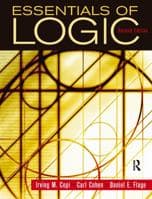
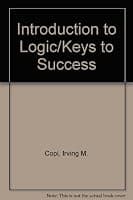
For more than six decades, and for thousands of students, Introduction to Logic has been the gold standard in introductory logic texts. In this fifteenth edition, Carl Cohen and Victor Rodych update Irving M. Copi's classic text, improving on its many strengths and introducing new and helpful material that will greatly assist both students and instructors.
In particular, chapters 1, 8, and 9 have been greatly enhanced without disturbing the book's clear and gradual pedagogical approach.
Specifically:
Chapter 1 now uses a simpler and better definition of "deductive validity," which enhances the rest of the book (especially chapters 1 and 8-10, and their new components)
Chapter 8 now has:
Simpler definitions of "simple statement" and "compound statement"
More and more detailed examples of the Complete Truth-Table Method
Chapter 9 now has:
A detailed, step-by-step account of the Shorter Truth-Table Method (with detailed step-by-step examples for conclusions of different types)
A more complete and detailed account of Indirect Proof
A detailed justification for Indirect Proof treating each of the three distinct ways in which an argument can be valid
A new section on Conditional Proof, which complements the 19 Rules of Inference and Indirect Proof
Explications of proofs of tautologies using both Indirect Proof and Conditional Proof
A new section at the end of the chapter explaining the important difference between sound and demonstrative arguments
The Appendices now include:
A new appendix on making the Shorter Truth-Table Technique (STTT) more efficient by selecting the most efficient sequence of STTT steps
A new appendix on Step 1 calculations for multiple-line shorter truth tables
A new appendix on unforced truth-value assignments, invalid arguments, and Maxims III-V
In addition, a Companion Website will offer:
For Students:
A Proof Checker
Complete Truth Table Exercises
Shorter Truth-Table Exercises
A Truth-Table Video
Venn Diagram Testing of Syllogisms
Hundreds of True/False and Multiple Choice Questions
For Instructors:
An Instructor's Manual
A Solutions Manual
www.routledge.com/cw/9781138500860
This description may be from another edition of this product.
An excellent textbook for becoming acquainted with the basics of of logical thought. Highly recommended for students or teachers!
0
★★★★★
The latest and greatest...
By Thriftbooks.com User, April 17, 2006
Logic is not just for Spock; deduction (which, if you read this book, you'll discover is rather different) is not just for Sherlock Holmes. Many if not most students of philosophy over the past 50 years have had their beginning logic training from an edition of this book, 'Introduction to Logic' by Irving M. Copi, now in its twelfth edition, also now with a co-author listed, Carl Cohen. I first learned logic in a two-semester sequence through the philosophy department at my university from the fifth edition of Copi's text in the early 1980s, supplemented by other material from Copi and a few others on symbolic logic. Logic was required of philosophy majors; it was strongly recommended of majors in sciences and mathematics; it was preferred for students in social sciences. Indeed, the principles of logic contained in Copi's text would not be out of place in most any discipline. This introductory text is also recommended reading for those preparing for major placement examinations, such as the LSAT and the MCAT. Learning how to think, and recognising typical and non-so-typical flaws in argumentation and reasoning are vital in many professions; the applications for law and medicine are fairly clear. This new twelfth edition of the text includes a lot of extras, including LogicNotes with Practice Problems, which occasionally comes bundled with the text. The Overviews, marginalia with definitions and clarifications, and Visual Logic features are all things I wish I'd had in the earlier text I used. The text is divided into different sections, including Language, Induction, and Deduction. Each part is then subdivided into two parts, A and B (logical, isn't it?). Language issues look at aspects such as definitions, informal fallacies in language, the question of meaning, truth and validity, and how to recognise argument forms. Deduction, what Sherlock Holmes always claims to be engaging, is a method whereby the validity of the premises provide the truth of the conclusion. In fact, Holmes usually engages in Inductive reasoning, including arguments by analogy and establishing probabilities, but not certainties. Also, the first two chapters are now separated out to introduce key concepts earlier and more directly. This book beyond the introductory chapters on language arguments engages in symbolic logic -- rather like mathematics, it uses non-linguistic tools to work out the framework. The pieces of symbolic logic (fairly standard across the discipline, like mathematics) are introduced in various stages as inductive and deductive reasoning are developed. Copi and Cohen look at both classical and modern symbolic logic systems. Copi and Cohen look at real-life applications, particularly as logic relates to scientific reasoning and social science reasoning. While this is not a mathematics text, it introduces some elements useful in mathematics, particularly in probability and in elements used in statistical reasoning. This text can be used for
3
★★★★★
Best Overview of Philosophical Logic
By Thriftbooks.com User, October 11, 2005
Copi's introduction to both inductive and deductive logic is one of the best surveys of philosophical logic in print. It's highly accessible and covers a lot of territory, more than any other introduction I've encountered. It's only drawback is its superficiality, as it doesn't fully cover probability, mathematical calculus, boolean logic, decision trees, or theorems and proofs.. The book begins with the uses of language, fallacies, arguments in ordinary language, Venn Diagrams, and then proceeds to symbolic logic, Aristotlean and a cursory overview of predicate calculus, quantification, science and hypothesis, analogy and probability (especially Mill's four rules of causal inference), and concludes with logic and the law (as a practical example of the application of logic). This book would make an excellent text for an introduction to philosophical logic and arguments. There are definitely superior books that deal with each of the above subjects individually, but none that I know that covers such broad terrain in a short amount of space. As more and more colleges and universities mandate some course in critical thinking, I cannot think of a better text for an introductory overview. If this is the text, take the course. (Eighth Edition)
2
★★★★★
Essential for Building Analytical Skills
By Thriftbooks.com User, June 2, 2003
This textbook is the most valuable I've ever read. It covers all the basic stuff, like fallacies, syllogisms, truth-functional logic, and second-order predicate calculus, omitting only cutting edge stuff like modal and fuzzy logic--and gives full, lucid, elegant explanations. What's more, it shows you how logic applies to the real world by using a variety of interesting examples--something MY logic professor never bothered doing. I can guarantee you that, if you read this book carefully from cover to cover and do all the exercises and PRACTICE applying them, you will become a much smarter, more effective person. (Example: after working through this book, I was able to score in the 99th percentile on the LSAT). Anyone planning on becoming a lawyer, a scientist, or even a journalist will acquire extensive and essential analytical skills by using Copi's magnificent textbook.
0
★★★★★
Superb
By Thriftbooks.com User, May 18, 2003
All I can do is echo the many enthusiastic reviews this book has already received. Copi covers a wide array of logics, formal and informal, classical and modern, and demonstrates their applications using real-life examples drawn from science, political journalism, and the law. He is lucid, nuanced, and insightful. Reading this remarkable textbook is the equivalent of taking introductory courses in symbolic logic, rhetoric, philosophy of science, and legal reasoning. I learned more from this one book than from an entire year at UC Berkeley. It's a keeper!