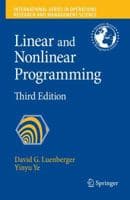
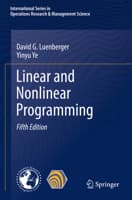
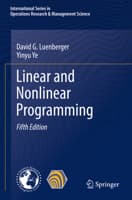
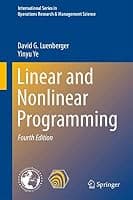
This third edition of the classic textbook in Optimization has been fully revised and updated. It comprehensively covers modern theoretical insights in this crucial computing area, and will be required reading for analysts and operations researchers in a variety of fields. The book connects the purely analytical character of an optimization problem, and the behavior of algorithms used to solve it. Now, the third edition has been completely updated with recent Optimization Methods. The book also has a new co-author, Yinyu Ye of California’s Stanford University, who has written lots of extra material including some on Interior Point Methods.
This description may be from another edition of this product.
This is a classic textbook with many sparklingly original ideas when it was first published in the early seventies. In the new edition the book is brought up to date with material on interior point methods, among others. The book covers both linear and nonlinear programming, and is written with mathematical rigor, but also with simple intuitive language. An excellent entry point to both linear and nonlinear programming.
0
★★★★★
Great deal! Quick shipping!!!
By Thriftbooks.com User, October 3, 2009
I received the book within one week. The book was brand new and I am very happy with the deal!
0
★★★★★
A book on mathematics that also an engineer can read
By Thriftbooks.com User, November 24, 1999
I have profitably used the book to apply constrained minimization procedures in the field of computational contact mechanics. I think it is not a secret that quite often books on mathematics are written from matematicians for matematicians. Hence it is quite hard for engineers both to read and to extract valuable information from them. With this respect this book is a shining star. It presents the topics in a very precise but clear and understandable way. Moreover the notation also is the best compromise between coinciseness and clarity. Matematicians, please, look at this book and follow such style; we engineer desperately need to communicate with you.
0
★★★★★
A necessary book for all who want to read and learn!
By Thriftbooks.com User, August 2, 1999
I have the 1977 edition from my father's MIT days. I am a Mathematician and I can verify that the book written in 1977 is of the same style that good books have today! A book is not made obsolete because some new "elegant" terms arise. Ok Luenberger did not know about Interior Point Algorithms and to tell you the truth why should he? I do not know other editions but in the first edition in chapter 7 "Basic Descent Methods" everyone who is able to read clearly and unbiased the second paragraph will agree with me that Interion Point Algorithms IS NOTHING NEW in the theory of MATHEMATICS!!! What you need to know ,the magic, is in the chapters 7-11. From there you can read everything else you like and get in touch with what is about to come in the next 25 years(See Ye : "Interion Point Algorithms"). But remember you are already in stars before reading the new books...