


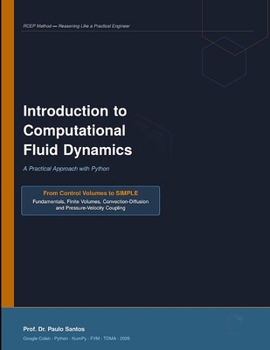
Introduction to Computational Fluid Dynamics: A Practical Approach with Python

Stop treating CFD as a black box.
Have you ever run a simulation in ANSYS or OpenFOAM, watched the colorful results appear on screen - and had no idea whether they were correct?
Commercial software is powerful, but it hides what actually happens in the calculations. When something goes wrong, you don't know where. When your advisor or client asks "why this value?", you freeze.
This book solves that. It takes you by the hand, from the ground up to pressure-velocity coupling, building your own simulators in Python on Google Colab - free, no installation required.
Based on the RCEP Method (Reasoning like a Practical Engineer), each chapter follows the same path: formulating the conservation equations, discretizing with the Finite Volume Method, implementing the code, and validating against exact analytical solutions. When the numerical result matches the theory, you KNOW you understood it.
WHAT YOU WILL MASTER:
The four fundamental equations of CFD, with clear physical meaningThe Finite Volume Method (FVM), step by stepThe TDMA algorithm implemented from scratch in PythonTransient conduction validated with Fourier seriesConvection-Diffusion: CDS and Upwind schemes, and why the choice changes everythingTwo-dimensional conduction in a plateThe SIMPLE method - the heart of modern CFDLid-driven cavity flow, validated against Ghia, Ghia & ShinFlat-plate boundary layer, compared with the Blasius solutionEverything in Python, with NumPy and Matplotlib, and analytical validation at every step. All graphs and tables in this book were generated by actually running the programs, which are included and ready to run on Google Colab.
WHO THIS BOOK IS FOR:
Undergraduate and graduate engineering students (Mechanical, Aerospace, Energy, Chemical, Civil)Engineers who use ANSYS/OpenFOAM but want to understand the method from the insideResearchers who need to implement and defend their own modelsAnyone entering the field of simulation with a solid, practical foundationThis is not a software tutorial. It is the method from the inside.
ABOUT THE AUTHOR:
Prof. Dr. Paulo Santos holds a PhD in Mechanical Engineering from UFSC, where his doctoral thesis was awarded Best Thesis of the Year and received an Honorable Mention in the CAPES Award. Part of his doctorate was completed at the Universit t Stuttgart, Germany - a world reference in fluid mechanics. A recipient of the Young Inventor Award and holder of registered patents, he has published numerous articles in peer-reviewed journals and brings nearly 20 years of experience in CFD research, industry, and teaching. He is the founder of LabEP (Practical Engineering Laboratory), creator of the RCEP Method, and shares didactic CFD content on his YouTube channel.
Customer Reviews
ThriftBooks ® and the ThriftBooks ® logo are registered trademarks of Thrift Books Global, LLC
