


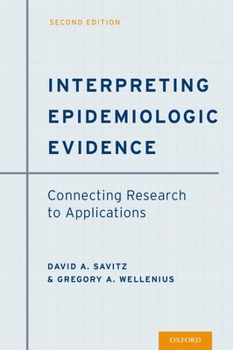
Interpreting Epidemiologic Evidence: Connecting Research to Applications

Select Format
Select Condition 
Book Overview
Epidemiology, the so-called "science of public health," has undergone a boom in the last decade as public interest and engagement in population health has skyrocketed. While this boom has done much to spark advances in the technology of epidemiology, it has also made it harder for those who want to use epidemiology to guide policy and clinical practice to fully appreciate the meaning of the research findings. Interpreting Epidemiologic Evidence offers those who have had an introductory course in epidemiology the knowledge they need to make clear connections from research findings to practical applications. Written in clear and lively prose, it empowers students at all levels to evaluate a study's design, implementation, and ultimate findings, giving the guidance needed to apply the information appropriately. Liberal use of practical examples serves both to illustrate core concepts and to motivate readers to think critically about the causal connections that population health studies aim to explore. Completely revised and updated, this new edition of Interpreting Epidemiologic Evidence is an invaluable core text for both epidemiologists in training and practitioners across other disciplines with even an introductory knowledge of epidemiology.
Format:Paperback
Language:English
ISBN:0190243775
ISBN13:9780190243777
Release Date:July 2016
Publisher:Oxford University Press
Length:240 Pages
Weight:0.79 lbs.
Dimensions:0.4" x 6.1" x 9.1"
Customer Reviews
1 rating
Required reading for every epidemiologist
Published by Thriftbooks.com User , 16 years ago
This book by David Savitz is an important and welcome addition to the epidemiologist's library. I started reading it after my first year of doctoral studies but I did not fully appreciate the usefulness of Dr. Savitz's insights until after I started doing independent research as a academic physician-epidemiologist. The book is well-written and presents the various methodologic challenges faced by epidemiologic researchers in a logical and coherent way. The chapter on selection bias is particularly illuminating. Remarkably, all the information is presented in lucid prose without the use of mathematical notation. If you would like to get the most out of your research endeavours, this book is for you. I think it should be required reading for every epidemiologist.
Copyright © 2026 Thriftbooks.com
Terms of Use | Privacy Policy | Do Not Sell/Share My Personal Information | Cookie Notice | Cookie Preferences | Accessibility Statement
ThriftBooks ® and the ThriftBooks ® logo are registered trademarks of Thrift Books Global, LLC
ThriftBooks ® and the ThriftBooks ® logo are registered trademarks of Thrift Books Global, LLC
