


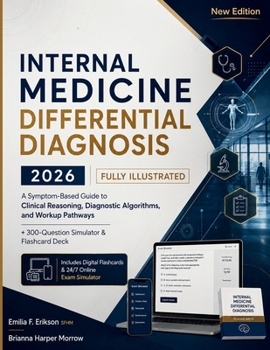
Internal Medicine Differential Diagnosis: A Symptom-Based Guide to Clinical Reasoning, Diagnostic Algorithms, and Workup Pathways + 300-Question Simul

Most internal medicine texts teach you about diseases. This one teaches you how to think. When a patient walks in with chest pain, fatigue, or altered mental status, you do not have a diagnosis. You have a symptom. This book begins there.
Written for medical students, residents, and practicing clinicians, it is organized entirely by presenting complaint. Each chapter walks you through the same structured approach: differential diagnosis by category, red flags and can't-miss diagnoses, focused history and examination, initial workup and diagnostic pathway, and advanced bedside reasoning.
Inside, you will find:32 symptom-based chapters. Fever, chest pain, dyspnea, abdominal pain, headache, syncope, jaundice, anemia, joint pain, and more. Find what you need fast.
Red flags and can't-miss diagnoses. Know immediately when to worry and what to rule out first.
Initial workup and diagnostic pathways. Step-by-step algorithms that guide your testing and referral decisions.
Advanced bedside reasoning. Deepen your clinical judgment with Bayesian thinking, cognitive bias awareness, and probabilistic frameworks.
Pretest probability and diagnostic test characteristics. Sensitivity, specificity, and predictive value applied to real clinical scenarios.
300 question exam simulator and digital flashcard deck. Integrated board prep to reinforce your learning and test your knowledge.
Why this book gives you an edge:Most differential diagnosis texts give you lists. This one gives you structure. It does not just tell you what could be causing the symptom. It shows you how to work through the possibilities, what to look for on history and exam, what tests to order and in what sequence, and how to avoid cognitive traps. It bridges the gap between textbook knowledge and clinical action. The integrated exam simulator and flashcards make it a complete study package.
For students learning clinical reasoning. For residents preparing for rounds. For practitioners who want a quick, reliable reference at the point of care.
Open it to find the diagnosis. Keep it close to sharpen your thinking.Customer Reviews
ThriftBooks ® and the ThriftBooks ® logo are registered trademarks of Thrift Books Global, LLC
