


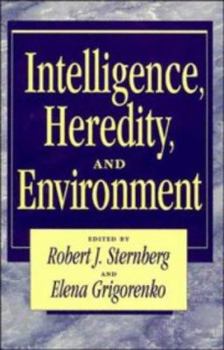
Intelligence, Heredity and Environment


Select Format
Select Condition 
Book Overview
Robert Sternberg and Elena Grigorenko address the roles and interaction of nature and nurture in Intelligence, Heredity and Environment, which provides a comprehensive, balanced, current survey of theory and research on the origins and transmission of human intelligence. The book is unique in the diversity of viewpoints it presents, and its inclusion of the most recent theories and findings. It highlights the search for genes associated with specific cognitive abilities, interactionist theories, cultural relativism, educational strategies, developmental perspectives and fallacies of previous intelligence research. This book will be required reading for students and professionals in the fields of intelligence, behavior genetics, biology, anthropology, and sociology.
Format:Paperback
Language:English
ISBN:052146904X
ISBN13:9780521469043
Release Date:January 1997
Publisher:Cambridge University Press
Length:632 Pages
Weight:1.81 lbs.
Dimensions:1.3" x 5.9" x 9.0"
Customer Reviews
1 rating
IQ heritability -- the emptiness of modern environmentalism
Published by Thriftbooks.com User , 18 years ago
Written 1998 For the past decade, the only serious worry for Sir Francis Galton's London School has been what might happen if impassioned academically-tenured critics of general intelligence (g) and heritability (h²) ever actually read the writings of psychologists Hans Eysenck, Art Jensen, Tom Bouchard and Sandra Scarr. From the mid-1980's, new twin and adoption studies were delivering impressive evidence of g's substantial heritability. Even the rogue hereditarian Sir Cyril Burt was being vindicated. Yet could there possibly be some flaw? It became clear in 1987 from 'Intelligence and Education' (Oxford : Clarendon) that such eminent critics of IQ as Maurice Schiff and Richard Lewontin had simply not read what the London School had to say. These critics did not realize that Eysenck and Jensen made precisely the allowance of IQ being 10-15% environmental for which Schiff's own adoption study provided further evidence. So what would happen if they and such tenured psychologists as Stephen Ceci, Howard Gardner and Douglas Wahlsten actually examined the hereditarian case? Might they actually find errors that had escaped attention because of their previous preference for dissociation? In the present volume, the feat of inducing reading by environmentalists has been achieved. The book supplies within the same covers the views of leading hereditarians, the replies of leading sceptics about g, and an amusing summing-up by Earl Hunt. Although Douglas Dorfman and Leon Kamin and the important non-psychologists Stephen J. Gould and Steven Rose do not appear for the sceptics, readers can have every reasonable assurance that academic opposition to London School views is unlikely to get stronger than the arguments advanced in these pages. This is an important publishing achievement, which is appropriately topped by a sensational revelation of how social-environmentalists have begun to shift their ground. Sadly, the hereditarians -- who bat first -- are not really on their best form. They have done it all so often before; but no-one reads it, so they become jaded. Sandra Scarr contents herself with old (though good) data; Art Jensen declines to use the breakthrough study by Phillipps (1993) showing that MZ twins, because of sharing the same placenta, actually draw apart from each other as one of them wins the competition for maternal blood supply; and the Colorado team is, as ever, so mesmerized by psychogenetic formulae that it will persuade precisely no-one. Fortunately, Tom Bouchard, does an excellent job of exposing the vacuity of latter-day opposition to heritability estimates. In particular, he refutes the claim that MZ twins become similar because they are treated according to their appearance. (Appearance has precisely *no* correlation with IQ.) John Loehlin and his Texan co-workers furnish the interesting statistic that adoptees reared together actually correlate negatively for IQ (at -.09, compared to +.24 in biological siblin
Copyright © 2026 Thriftbooks.com
Terms of Use | Privacy Policy | Do Not Sell/Share My Personal Information | Cookie Policy | Cookie Preferences | Accessibility Statement
ThriftBooks ® and the ThriftBooks ® logo are registered trademarks of Thrift Books Global, LLC
ThriftBooks ® and the ThriftBooks ® logo are registered trademarks of Thrift Books Global, LLC
