


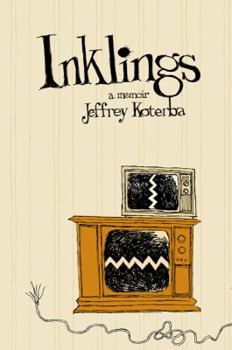
Inklings: A Memoir

Select Format
Select Condition 
Book Overview
When Jeffrey Koterba was six, he started drawing his first cartoons, painstakingly copying from the Sunday Omaha World Herald's funny papers and making up his own characters. With a pen and a sheet of... This description may be from another edition of this product.
Format:Hardcover
Language:English
ISBN:0151014922
ISBN13:9780151014927
Release Date:November 2009
Publisher:Houghton Mifflin Harcourt
Length:264 Pages
Weight:1.05 lbs.
Dimensions:9.0" x 0.8" x 6.0"
Customer Reviews
5 ratings
Talent and Determination
Published by Thriftbooks.com User , 16 years ago
What a fascinating read INKLINGS is. Jeffrey Koterba is the offspring of a domineering, alcoholic father, who created chaos in what could have been a stable, working-class environment; and his mother, who, while trying to bring calm to her family, endured and perhaps enabled the tumultuous atmosphere in their home. In addition to a job with the Union Pacific Railroad, Dad frequents garage sales and drags home non-working televisions and other perfectly good items and fills every available space with these projects in order to "support his family" by repairing and re-selling the items. I did a bit of uncomfortable reminiscing while reading about Dad. My own father had a secondhand store, which was partitioned off to provide us a home at the rear. Among the treasures my father brought home was a crate of live chickens that broke open and allowed the chickens to run amok. I have no idea what he planned to do with live chickens. Koterba's father is a self-proclaimed victim, and rejects any suggestion that his behavior has created near poverty and turmoil for himself and his family. Young Jeffrey used drawings to express himself, both his reality and his fantasy life, as soon as he could hold a pencil. Using drawings, he told his stories while avoiding the agony of talking while suppressing the tics that plagued him. He passed through early adolescence with few friends, but began to find the niche he needed at the high school newspaper. An indifferent student, except in art, he somehow managed to be admitted to the University of Nebraska where his talent for journalism, particularly editorial cartoons, blossomed. The final section of INKLINGS is where Koterba is finally able to describe his considerable success at his chosen career and at mending much of what was broken in his family. He was not handed an easy path to follow, so his triumphs are particularly heartwarming. How fortunate we readers are that he chose to write about himself.
Talent and perseverance triumph
Published by Thriftbooks.com User , 16 years ago
Who doesn't like the story line of the young man who overcomes difficult circumstances to triumph in the end? This is the kind of story that great movies are made from. And it certainly would be a wonderful screen-worthy story. (Are you listening out there, Hollywood?) I had never heard of Jeffrey Koterba but like many, I've seen his cartoons numerous times. His memoir definitely illustrates the adage, "That which does not kill us, makes us stronger." He grew up with a father who was a frustrated inventor, alcoholic, social outcast, garage sale addict, and who also had Tourette's syndrome. Koterba's mother was always supportive but often overwhelmed by her husband's excess ..and misdirected energy and ideas. She encouraged Jeffrey early on with a John Gnagy Learn to Draw book, hiding typing paper, and generally being there for him. "It's hard to make the nervous habits stop, and nearly impossible when I'm frightened or worried about my family." Koterba had plenty to worry about. Living hand-to-mouth in a junk-filled home, he just kept putting one foot in front of the other. He didn't find out until he was a teen that the "liver pills" he'd been prescribed were really anti-depressants...presumably to control his Tourettes. As a memoir, the book follows his life, ups and downs...and plenty of downs...to his final triumph. Drawing for the school paper. Working for the Omaha paper at age 16. Getting struck by lightning. National recognition. Probably most symbolic of Koterba's life was his first car purchase, an old Chevy Impala for $200 which had a transmission that wouldn't go in reverse. Koterba could never go back...he could only go forward. And he did. If you are a lover of memoirs and inspiring life stories, you'll love this book.
Humorous Memoir
Published by Thriftbooks.com User , 16 years ago
Political cartoonist and musician Jeffrey Koterba revisits his childhood with his humorous memoir INKLINGS. Having grown up during the 1960s and 1970s, Koterba was influenced by television culture and the Sunday funnies, which resonates with his impressionable renderings of cartoon strips that were inspired by Peanuts to The Wizard of Id that came with the Sunday edition of the Omaha World-Herald; coincidently, he would later become a cartoonist with the paper. Despite the reference of Koterba's family as being dysfunctional, which may be attributed to how his father never so-called sugarcoated the truth, picture Archie Bunker rather than Ward Cleaver. However, this did not deter Koterba as well as his brother Artie from overcoming obstacles and endless family squabbles that they encountered as children and later in adulthood. Indeed, the book does not read as cut and dry as any typical memoir. His life has been a unique journey as highlighted within each page that vividly retells his momentous experiences as a young boy doodling, spending uncompromising times with relatives during the Christmas holidays, and playing in various rock and roll bands shrouded with Tourette's Syndrome; a condition he was not aware of until he was in his thirties. But the most interesting aspect of Koterba's memoir centers upon his father who worked as a bookkeeper for the Union Pacific Railroad and also repaired televisions at home; interestingly, having been a drummer in jazz bands and orchestras, and once playing with a young Johnny Carson, Koterba's father's passion for music left a lasting impression on him. INKLINGS is an extremely comedic and sentimental narrative. The story could have easily been included within a Rolling Stone or New Yorker article, or it could possibly be a screenplay for a film or sitcom. There is no doubt that this book is worth reading more than once.
What a Memoir Should Be
Published by Thriftbooks.com User , 16 years ago
So often, memoirs are written by people who have had tough upbringings or difficult lives. Their travails are what moves the book, with not much more material for a reader consider other than to shake his head and be pleased it was not his life. Mr. Koterba's memoir seemingly starts the same way. He has undiagnosed Tourette's syndrome as does his father. His father is also a tad whacky, to put it mildly, filling his house, porch, yard and two garages with yard sale cast-offs, especially TV's that he repairs for resale. The first third or so of the book is tracking the difficulties Mr. Koterba has as a youth being the blackest sheep of a black sheep family. However, as he grows older and begins to emancipate himself from the household, he comes to the realization that there is much more to his family than tinkering with scrap heap mechanical devices, yelling, drinking and paranoia. As he grows older, he grows to appreciate that there was depth in his family all along and maybe his life wasn't so so bad after all. Eventually his Tourette's was diagnosed. His handling of that, although only cursorily explored, is very interesting. His father contends that they just have "nervous habits". This book is far better than a run-of-the-mill memoir of a dysfunctional family and upbringing. Although it includes the over-coming the adversity of Tourette's and a dysfunctional family, Mr. Koterba is so adroit at just relating his life story without taking any credit that it is heart-warming rather than preachy. Highly recommended.
Korterba is a man of many talents
Published by Thriftbooks.com User , 16 years ago
I ordered this book thinking that it was an artist's memoir in graphic novel format, so I was a bit disappointed that it is a narrative; however after reading a few pages, I was surprised and pleased to find out that Jeffrey Koterba is not only a highly successful cartoonist, but that he is also an excellent writer. "Inklings" is Korterba's first book, and I found it to be an engrossing and enjoyable read. His family life was dysfunctional and WEIRD--especially his pack-rat dad--but it didn't turn out to be a "boo,hoo, look at me, my life sucks" kind of thing. He writes about his life and his family members in an honest, yet sympathetic way. Throughout his life he suffers from "twitches", like his father, but is not diagnosed with Tourette's Syndrome until he is 30 years old. This syndrome, like the special creativity that often goes along with it, is hereditary. His dad has the same problem, but he just told Jeffrey that he has "nervous habits" like he does. The reader can clearly see how this "disability" has affected the author and those around him, yet the story certainly does not revolve around the Tourette's. In the course of the book mysteries of his family come to light, and as they grow older, they seem to understand and appreciate one another more. For example, his younger brother Artie is his dad's helper and favorite son, which puts a wedge between the two boys. In the last vignette, though, where Artie and Jeffrey meet and talk together, their obvious love and connection shines through. I just stayed up most of the night reading this great book; hopefully I can write some more about it later! Enjoy!
Copyright © 2026 Thriftbooks.com Terms of Use
| Privacy Policy | Do Not
Sell/Share My Personal Information | Cookie Policy | Cookie Preferences | Accessibility Statement
ThriftBooks® and the ThriftBooks® logo are registered trademarks of Thrift Books Global, LLC
ThriftBooks® and the ThriftBooks® logo are registered trademarks of Thrift Books Global, LLC
