


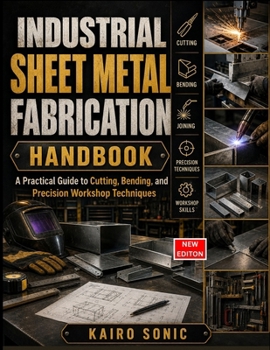
Industrial Sheet Metal Fabrication Handbook: A Practical Guide to Cutting, Bending, and Precision Workshop Techniques

What separates an accurately fabricated metal component from one that requires costly corrections? Often, it comes down to understanding the material, choosing the right technique, and getting the details right before the first cut.
Sheet metal fabrication is more than cutting and bending metal. It requires a practical understanding of measurements, material behavior, fabrication layouts, forming methods, joining techniques, and precision workmanship. Whether you are developing your technical skills or strengthening your knowledge of industrial metalworking, understanding how these processes work together can make a significant difference in the quality of your results.
Industrial Sheet Metal Fabrication Handbook provides a practical introduction to the principles, processes, tools, and techniques involved in sheet metal fabrication. It is designed to help readers build a clearer understanding of how flat metal stock is transformed into functional components through careful planning, accurate measurements, controlled forming, and appropriate finishing methods.
WHAT YOU'LL EXPLORE INSIDE- Materials and Metal Properties: Understand common sheet metals, material characteristics, thickness measurements, and considerations when selecting materials for fabrication tasks.
- Tools and Workshop Equipment: Become familiar with essential hand tools, measuring instruments, cutting equipment, and machinery used in metal fabrication environments.
- Technical Drawings and Layout: Explore the fundamentals of interpreting fabrication drawings, taking measurements, marking out materials, and preparing layouts for accurate work.
- Cutting and Preparation Methods: Learn about common cutting approaches, material preparation, and the factors that influence clean, accurate cuts.
- Bending and Forming Techniques: Develop an understanding of bending principles, press brake operations, bend allowances, forming methods, and the importance of controlling dimensions.
- Joining and Assembly: Discover the principles behind common joining methods, including mechanical fastening, riveting, welding, and other techniques used to assemble metal components.
- Precision and Quality Control: Explore dimensional accuracy, tolerances, inspection practices, and common fabrication errors that can affect the quality of finished work.
- Workshop Safety and Best Practices: Understand the importance of safe equipment operation, appropriate protective equipment, material handling, and organized workshop procedures.
WHY THIS HANDBOOK BELONGS IN YOUR TECHNICAL LIBRARYSuccessful fabrication depends on more than knowing how to operate a machine. It requires an understanding of why a particular process is appropriate, how material properties influence the result, and which measurements must be checked before a component moves to the next stage.
This handbook brings together essential fabrication concepts to help readers develop a more structured approach to metalworking. It can serve as a learning resource for beginners, a supplementary reference for technical students and apprentices, and a useful knowledge-building resource for individuals working in fabrication-related environments.
Whether your interests involve industrial production, workshop fabrication, equipment enclosures, sheet metal components, or general metalworking, a stronger grasp of fabrication fundamentals can help you approach technical tasks with greater confidence.
Understand the process. Improve your precision. Build your fabrication knowledge.
Explore the principles and techniques behind industrial sheet metal fabrication with a practical handbook designed to support your learning and professional development.
Customer Reviews
ThriftBooks ® and the ThriftBooks ® logo are registered trademarks of Thrift Books Global, LLC
