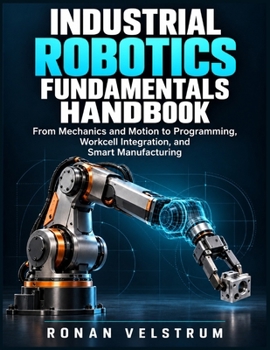
Industrial Robotics Fundamentals Handbook: From Mechanics and Motion to Programming, Workcell Integration, and Smart Manufacturing

A robot can move exactly as programmed and still fail the manufacturing task. The difference often lies in how mechanics, sensing, tooling, and the rest of the workcell fit together.
When those subjects are learned separately, important questions remain unanswered. Does the tool load fit the movement? Does the sensor value describe the right place and time? Does an acknowledgment confirm the physical result? Will a simulated sequence remain meaningful after installation or a configuration change?
This handbook connects the fundamentals to those application questions. Across 16 chapters and 50 figures, it moves from robot structures, coordinate frames, and kinematics to motion, drives, control, programming, and integrated production. Calculations are developed with stated variables, units, assumptions, and limits so that you can examine both the result and its meaning.
Inside, you will learn to:
Interpret robot architectures, workspaces, tool offsets, and load paths when assessing what a machine can contribute to a task.Connect tool poses and joint configurations to trajectory planning, torque demand, drive constraints, and feedback performance.Evaluate sensing, machine vision, calibration, measurement uncertainty, gripping, and process tooling as parts of the same operation.Trace task states, input qualification, machine handshakes, timing, and recovery through observable physical results.Examine workcell layouts, production dependencies, collaborative applications, simulation limits, digital twins, and industrial cybersecurity.Organize commissioning evidence, maintenance records, fault investigations, feasibility checks, and economic comparisons around a defined application.Worked examples show the reasoning behind motion profiles, gripping forces, calibration relationships, production timing, and investment calculations. Practice problems with explained answers support active study. A glossary, mathematical and unit-conversion appendix, planning and acceptance worksheets, and index help you return to the material when a specific question arises.
The book is written for engineering students, technicians working with automated equipment, and engineers seeking a connected account of the fundamentals. Basic algebra is expected; additional mathematical ideas are introduced in context. Educational examples support understanding and do not replace current equipment instructions, qualified assessment, or validation of a physical installation.
Get your copy and begin connecting the mechanics of the robot with the programming, integration, and engineering evidence behind a complete manufacturing workcell.
Customer Reviews
ThriftBooks ® and the ThriftBooks ® logo are registered trademarks of Thrift Books Global, LLC