


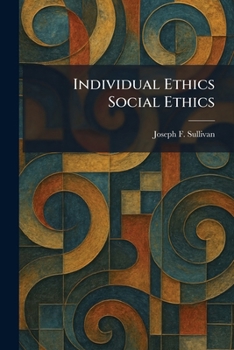
Individual Ethics Social Ethics

"Individual Ethics Social Ethics" is a comprehensive exploration of moral philosophy, meticulously examining the principles that govern human conduct in both private and public spheres. This work serves as a foundational treatise on ethical living, rooted in the scholastic tradition of the early twentieth century. It delves into the nature of human acts, the concept of law, and the moral obligations that individuals owe to themselves, their neighbors, and the broader community.
The first part of the work focuses on individual ethics, addressing topics such as the ultimate end of man, the morality of human actions, and the development of virtues. It provides a rigorous framework for understanding conscience and the dictates of natural law. The second section transitions into social ethics, analyzing the rights and duties inherent in social institutions, including the family, the state, and the international community. The text provides a clear-eyed defense of social justice and the common good, offering a perspective that balances individual liberty with communal responsibility.
This scholarly work remains a significant contribution to the field of moral theology and philosophy, offering timeless insights into the ethical challenges that face humanity. It is an essential resource for students of philosophy, theology, and anyone seeking a structured, principled approach to the moral life.
This work has been selected by scholars as being culturally important, and is part of the knowledge base of civilization as we know it. This work was reproduced from the original artifact, and remains as true to the original work as possible. Therefore, you may see the original copyright references, library stamps (as most of these works have been housed in our most important libraries around the world), and other notations in the work.
This work is in the public domain in the United States of America, and possibly other nations. Within the United States, you may freely copy and distribute this work, as no entity (individual or corporate) has a copyright on the body of the work.
As a reproduction of a historical artifact, this work may contain missing or blurred pages, poor pictures, errant marks, etc. Scholars believe, and we concur, that this work is important enough to be preserved, reproduced, and made generally available to the public. We appreciate your support of the preservation process, and thank you for being an important part of keeping this knowledge alive and relevant.
Customer Reviews
ThriftBooks ® and the ThriftBooks ® logo are registered trademarks of Thrift Books Global, LLC
