


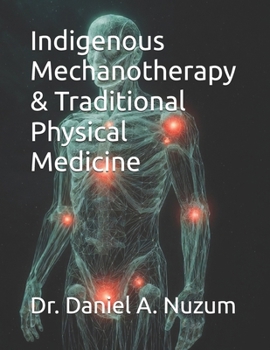
Indigenous Mechanotherapy & Traditional Physical Medicine

The body isn't broken. It's responding.
That single idea changes everything about how you touch a patient, when you intervene, and why most manual therapy produces temporary results. Indigenous healers across North America understood this for thousands of years. Modern practitioners are only now catching up.
Indigenous Mechanotherapy & Traditional Physical Medicine is the first textbook to trace hands-on healing from its origins in Lakota, Cherokee, Navajo, and other tribal healing systems through osteopathic and Eclectic traditions into a complete clinical framework for today's practitioner. But this isn't a history book. It's a working manual built around a provable reality: the nervous system governs all change in the body, and if you don't have its cooperation, your technique doesn't matter.
Dr. Daniel Nuzum spent decades studying across disciplines (naturopathic medicine, osteopathy, mechanotherapy, Indigenous healing, Oriental medicine, integrative pharmacology) and kept finding the same biological laws underneath all of them. That work produced the Four-Phase Healing Framework: Stabilization, Detoxification, Fortification, Thrive. It's a sequencing model that explains why patients plateau, why symptoms cycle back, and why doing less at the right moment produces more change than forcing correction on a body that isn't ready.
The book covers mechanotransduction and why touch becomes biology. Fascial physiology and how connective tissue acts as a sensory organ. Palpation as a diagnostic tool, not just a technique. Spinal and joint manipulation, soft tissue therapies, hydrotherapy, and advanced clinical integration. Every method is taught through the lens of nervous system regulation and phase-appropriate timing.
There's a question most practitioners never get trained to ask: is this body ready to change? If the answer is no, everything you do creates resistance instead of resolution. This text teaches you how to read that answer before you ever apply force.
Written for naturopathic students, osteopathic practitioners, manual therapists, and integrative clinicians who want clinical reasoning that actually holds up across patient populations. Includes phase identification protocols, observational assessment frameworks, and case-based clinical thinking developed through decades of real-world patient care.
You're not here to fix the body. You're here to understand it, restore the conditions it needs, and get out of the way.
Customer Reviews
ThriftBooks ® and the ThriftBooks ® logo are registered trademarks of Thrift Books Global, LLC
