Skip to content
ISBN: 0070240086
ISBN13: 9780070240087

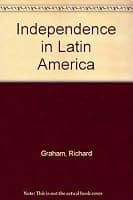
Independence In Latin America: A Comparative Approach

$6.99List Price: $28.12
Save $21.13!
ISBN: 0070240086
ISBN13: 9780070240087

Conditions

A read copy, but remains in excellent condition.

Conditions

A read copy, but remains in excellent condition.

Book Overview

This work outlines the complex proccesses through which Latin America became independent of Spain and Portugal in the first quarter of the 19th century. The author argues that three major forces shaped the contours of independence: the rise of a single world economy driven especially by the rise of industrial capitalism in England; the response of the Latin American elites as they sought to gain advantage from these changes; and the constant pressure exerted upon the elites by Indians, mestizos, blacks, slaves and the poor generally. This description may be from another edition of this product.
Format:
Paperback
Language:
English
ISBN:
0070240086
ISBN13:
9780070240087
Release Date:
January 1994
Publisher:
McGraw-Hill Humanities/Social Sciences/Languages
Length:
144 Pages
Weight:
0.50 lbs.
Dimensions:
8.0″ × 0.6″ × 5.5″
AmericasCentral AmericaHistoryLatin AmericaSouth AmericaWorld

More by Richard Graham

Customer Reviews

1 customer rating | 1 review
Write a Review

Latin America's Road To Freedom

Interesting, yet compact history of Latin America's independence movements is good enough to satisfy the knowledge of most who don't wish to read similar books of more than 200 pages. Published by McGraw-Hill, "Independence in Latin America: A Comparative Approach" covers most of the movements in the region, from Mexico to Chile's Tierra de Fuego. Author Richard Graham does a great job in identifying the main reasons the uprisings against Spanish, Portuguese, and French rulers happened. The emergence of England's commercial status, the attitudes towards Creoles, and finally the Napoleonic Wars were all causes that broke the colonial ties these new republics (and in Brazil's case, an "Empire") had with Madrid, Lisbon, and Paris.The only thing very negative about this book was that the author decided to cover Haiti's independence movement, but never did cover that of the Dominican Republic, Cuba and Puerto Rico. The latter two, which gained independence and autonomy respectively after the Spanish-American War of 1898, have always been in the world's political spotlight then and now. It would have been interesting for Mr. Graham to cover these because their struggle was the longest independence war in the region's history (more than 10 years).While the Dominican Republic gained their independence from Haiti's black rulers (the French and Spanish had fled the island after the Haitian Revolution), it would be important to cover this too. That country's struggle to break free from Haiti shows that even newly created republics in the Americas were able to be as suppressive as their European masters were. Overall, this 180 page book is a great way to immense yourself in the history of one of the world's most important, and rising regions.

0