


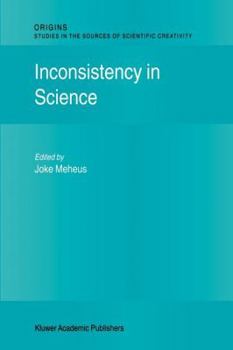
Inconsistency in Science
No Customer Reviews

Select Format
Select Condition 
Book Overview
For centuries, inconsistencies were seen as a hindrance to good reasoning, and their role in the sciences was ignored. In recent years, however, logicians as well as philosophers and historians have showed a growing interest in the matter. Central to this change were the advent of paraconsistent logics, the shift in attention from finished theories to construction processes, and the recognition that most scientific theories were at some point either internally inconsistent or incompatible with other accepted findings. The new interest gave rise to important questions. How is 'logical anarchy' avoided? Is it ever rational to accept an inconsistent theory? In what sense, if any, can inconsistent theories be considered as true? The present collection of papers is the first to deal with this kind of questions. It contains case studies as well as philosophical analyses, and presents an excellent overview of the different approaches in the domain.
Format:Paperback
Language:English
ISBN:9048160235
ISBN13:9789048160235
Release Date:December 2010
Publisher:Springer
Length:223 Pages
Weight:0.74 lbs.
Dimensions:0.5" x 6.1" x 9.2"
Related Subjects
History Philosophy Science Science & Math Science & Scientists Science & TechnologyCustomer Reviews
0 rating
Copyright © 2026 Thriftbooks.com
Terms of Use | Privacy Policy | Do Not Sell/Share My Personal Information | Cookie Policy | Cookie Preferences | Accessibility Statement
ThriftBooks ® and the ThriftBooks ® logo are registered trademarks of Thrift Books Global, LLC
ThriftBooks ® and the ThriftBooks ® logo are registered trademarks of Thrift Books Global, LLC
